The reviews I read (that I agree with) said that you have to approach the movie without any cynicism whatsoever, which is extremely hard to do. It also was obviously cut short, with many good moments left on the cutting room floor. I keep wondering how it would have worked with a novel, written by someone who could pull it off. The best part of the movie is the actors. It could have been atrocious, but the actors pulled off a very barren script and made it worth watching. The same cannot be said for, say, the latest Star Wars movies, (and no, I'm not gonna pick on Jake Lloyd here). C.J. Adams carries the whole movie on his shoulders, and does it with every inflection, every raise of the eyebrow. He's the Haley Joel Osment of this decade. Let's hope he doesn't mess it up like HJO did. Joel Edgerton and the other supporting cast did a likewise magnificent job. Also, the music score was great. I wish I would have listened to the soundtrack before I went to see the movie. I did that with Where the Wild Things Are, and it was amazing!
Ahmet Zappa, who wrote the script, obviously is highly intelligent, using references to literature all throughout. For instance, the story takes place around a pencil factory. Henry David Thoreau worked at a pencil factory early on, who famously wrote in Walden about "marching to the beat of a different drum." Timothy Green certainly does that. He's also very much a naturalist, working with his girl friend (Odeya Rush) to make the leaf palace. Also, the Pencil theme is famous because of an essay by Leonard Reed, (a prior blog goes into that) who goes into all the people who make a single pencil, all the individual jobs that go into constructing the eraser, the wood, the graphite. It is a magnificent essay of the free-market world, with each worker supporting the other. And while the movie has a decidedly anti-capitalist tone, the idea that individuals, working together, can support and lift up each other, creating, as it were, a better mouse trap, is a wonderful message for today's world.
The main criticism I have is the framed effect they use with the Adoption Office. I wonder how it would have changed to leave that part out. It gives away the ending, right at the start. You know what will happen all throughout, and it puts a sad tug the whole time (probably intended.)
Speaking of that sad tug, I walked out of the movie feeling much like I did when I saw Pay it Forward. I probably would have cried at some point, but I didn't have time to. I had to go to work afterwards, and there just wasn't time. And that got me to thinking, we just don't have the time to experience all the emotions that come with our lives. We're too busy living at 45 when we should be at 33 and1/3. Try playing a 33 record at 45 on a turntable. The singers sound like chipmunks, and you lose so much of the emotional pull of the music involved. Barry White would become very un-Barry Whitish, if you get my meaning. Sometimes it's best to be like Thoreau, to watch the ants go back and forth.
In the end, I would put this movie in the same category with Pay it Forward, A.I., Where the Wild Things Are, (all underrated movies that are some of my most favorite) which are movies about kids, but definitely not for kids. Disney's commercials for the movie on their own channel are actually misleading in how "supernatural" CJ Adams character actually is. In fact, he's just a normal kid, with leaves growing out of his legs.
Have you read The Little Prince? I'm sure we're all familiar. Kid lives on a planet (B612) with a half-a-house, a Rose Girl, and three volcanoes (one extinct). And that's all. The space geese fly him up to where comets are coming by and he snatches one with a butterfly net and whizzes off other worlds. I feel like he does, a lot of the time, trapped on that tiny microcosm of a planet, waiting for the right chunk of rock to take me someplace different. Except, for this traveler, the worlds exist in my head. I guess they all exist in our heads, and we strive to create these worlds for ourselves. We dream them every night, worlds similar to our own, but more fantastic. If I could build the bookstores I've seen in my dreams, they would be truly amazing! It seems our society has become enamored with playing God, in our dreams, our writings, in the images that flash upon the wall, and, for people in my generation or younger, in our video games. We've created world after world to escape into, from the most primitive of pixelation, Commander Keen, for instance, to the epic worlds that Nintendo and the like have created. And I have gone into my fascination with The Legend of Zelda games before, and I curse Nintendo for putting the new games on a system where you actually have to move to enjoy the full effect of the game. I just want to press buttons. But I digress...
The most recent games I've been playing are Where the Wild Things Are, reviewed here. This video game is uniquely designed, for the book has no real plot, at least, not on the island. And so
the game designers had to look to their own imaginations, and Maurice Sendak and David Eggers' movie script, to develop this amazing piece of literary real estate. And with that, they did such a wonderful job. What a lot of the reviewers online don't get is that the game isn't really about hack 'n slash, killing enemies, or even winning the game. Instead, it's about the island itself, and the characters. It's jumping into a world where there are no chores, no going to work, no dealing with insane customers and co-workers. It's jumping into a world of forests, mountains, furry creatures that have problems, but not real ones. It is escapism into what Tolkien called the land of Faerie, the undeveloped potential that comes forth in our dreams and fantasies. It becomes the lands of Narnia, Fantasia, Middle-Earth, and Where the Wild Things Are, because each of those worlds existed inside of their creators. And how wonderful are each of the makers that they would share that land with us, to exist in for just a little while?
With each video game, the goal is to make a world out of that mold so that we can all exist inside of it, but also to make it entertaining. There must be evil as well as good, something to threaten the very peace that we yearn for inside those realms. A game about Transformers wouldn't be very exciting if there were no Decepticons to keep things lively, even as much as I don't like 1st person shooters, you have to have something to shoot at.
But back to literature.... children's picture books provide a grand opportunity for video game makers to do whatever they want with the world within the pages, as long as it fits into the mold the author originally intended. How marvelous would it be to take the illustrations of Colin Thompson and turn them into video games? They would be perfect for the "hidden object" genre, but I think it would be better to delve into the lands he created at the corners of our world. Seriously, everyone needs to pick up Searching for Atlantis and gander at it for a while.
Other picture books that would make great games.... Harold and the Purple Crayon would work well as a Wii game or for the other interactive systems. Let us create our own worlds with crayons, solve puzzles, overcome bad guys, go outside the lines for a time. The books of Graeme Base would also make interesting video games. He's already got an App for those that play with such things. .. Chris Van Allsburg's Jumanji isn't a stretch at all (as I'm sure that's already been done, but probably for older consoles...a new refresh would be better). One last illustrator that has picture books ripe for video game adaptation would be David Wiesner. I am most familiar with his work Sector 7, which would make a wonderful racing game with a surreal feel to it.
But plot lines (and more words) make for better guidelines when making a video game, so games like American McGee's Alice can draw off of the author's talent as well as the designers. In Alice, the game is a sequel to the books by Lewis Carroll. Alice is the only survivor of a horrific fire that destroys her house and family. Then she is committed to a mental institution where she is drawn back into a twisted version of Wonderland, where the mangy Cheshire cat (with an earring now) teaches Alice to become a mean killing machine with the Vorpal Blade and a deck of cards. The lean, but spectacular, graphics of the first game are now replaced in Alice: Madness Returns with a gorgeous recreation of Wonderland (using the updated Unreal engine which didn't exist when the original was made in 1997). The background is filled with references to the literary work, although in often twisted ways. I have a feeling that, like WTWTA, critics are probably going to pan the ease of which the game is played, as well as the platform-ish characteristics, but those are what makes it fun. Sometimes the difficulty of a game gets in the way of being totally immersed in the world. A good balance turns the game from forgetful or nightmarish to totally engrossing. Take a look at the Final Fantasy or Zelda games for examples.
Some other books that should be made into Video Games:
Gulliver's Travels, by Jonathan Swift. In what would be called The Further Adventures of, Gulliver can go to any of the worlds in Swift's imagination, complete with the references to the world of British Academia, the moronic state of politics and war, etc... and then go to other worlds as fits the twisted mind of the Irish Satirist. One only has to read "A Modest Proposal" to see how outrageous he was in pointing out the problems of his society. Bring in subtle pokes at today's world, and there's a great game for anyone, adults or children alike. I've found this work on several sites that talked about Literary Works as Video Games.
The Little Prince by Antoine de Saint-Exupery. This one is already half done, with a French company having produced a CCG TV series with spectacular graphics and an engrossing plot that would make a great game for any age.
The Wizard of Ozby Frank L. Baum. This world parallels Alice's wonderland in magnificence and in plot, where a sequel or a spot on working of the original series (Baum made many books pertaining to Oz), would be amazing. Especially with upcoming renditions of the work being made in theatres. I suspect this will be coming in the not so distant future.
I would love to see a video game made of Steven Hall'sThe Raw Shark Texts. That would be fun, to battle beings made up of data, words, thoughts... this would be a great first person shooter game in the vein of Bioshock.
Michael Ende wrote The Neverending Story, and while I would love to find the hardback book that looks just like the one in the movie (one of my favorites), I would want the video game to be based on the book instead. The book is considerably different from the movie, with much more depth and wonders that would make for lots of playing time.
Andrew came up with a good idea, and I've seen it on quite a few similar lists before, as well. Because video games don't have to be just about fantasy worlds. I've always loved small town nostalgia, the yearning for simpler times, and so how ironic would it be to have Mark Twain's The Adventures of Huckleberry Finn as a video game. The book is very episodic, with plenty of action, or it could be more of a free flowing environment like the old Game Boy Advance title The Sims, Bustin' Out (great game, BTW). Story and Goal oriented, but with a fair amount of free play as well.
There are a number of worlds I'd love to see as a video game. Anne McCaffrey's Pern world would be great as an Ultima Online type world where you build up skills through learning your trade, as well as hopefully training a dragon and fighting Thread. Or Stephen R. Donaldson'sThomas Covenant Trilogy. Or one based on Ender's Game, by Orson Scott Card. I think that's already in the work, along with a movie. All the worlds out there in the dreamscape, from the minds of the great authors' who have molded their creations, expanded and pixelized by the computer programmers that can seemingly do anything with 1's and 0's. I guess the ultimate achievement would be Star Trek's Holodeck, but perhaps it's better not to live in our fantasy worlds all the time. That's why books, and video games, will have to suffice, for now.
It constantly amazes me how people identify with the Maurice Sendak book Where the Wild Things Are. I always keep copies behind the register for the times we are holding book drives for charitable organizations. Time and again people will come up, point at the book, say, "I remember that book!" and immediately add it to their order for donation. All this for a book in which nothing happens! The kid misbehaves, is sent to his room, in which, ostensibly as a dream, it turns into a forest, with a boat, with an island, with Wild Things on it. He plays, jumps, hangs from vines (on pages with no words) and then gets unhappy for whatever reason, and goes home. With his supper still hot. And yet so many people love this book. It's odd, because I don't remember ever reading the book as a child, and when I read the book, it really didn't stick with me as something major, like, say, Harold and the Purple Crayon, which is an amazing book and speaks volumes about the children's imagination. And yet something has connected in the psyche of the people reading it, for it won the Caldecott Medal for picture books. It must be something special.
So I go see the movie in the theatre, walk into the cinema room, and I'm the only one there. I loved it!! I sang with the songs, howled with the Wild Things, cried at the end. It was an utterly spectacular movie, my favorite now, and it comes from a book that is empty of most literary devices. See here for a review of the movie.
To round out the multimedia trilogy, I finished the video game for the PS3. And I (big shock here) loved it, too. I loved it for the same reason that everyone hated it. The platform game is simplistic, with few weapons or items to use. It is offline only, for one player, and the enemies consist of bugs and shadow gunk things. But it's a return to the Island where the Wild Things live. And the programmers make the Wild Things just like those in the movies, with the exact same personality, but they further them into the archetypes that they have been built around (on that later). It is escaping into a world where you (as Max) are completely alone with these giant furry thingees, and you get to experience the wonderment of this world without having to worry about PKers or other crap from the outside world. Every time KW or Carol gets stuck, I was emotionally drawn to freeing them from the gunk and the monsters, and achieving the "trophy" that had me not save them hurt. I had to turn off the sound while they sank into oblivion. Because the Wild Things are, as an entire set, part of Max's total psyche. That's what makes them archetypes. So let's look at who the Wild Things actually are.
I will freely admit that I did not come up with the idea of the Wild Things as Archetypes, although I respect greatly those that did, and will give credit where I can. It is not the first time that characters can be identified with the universal types of people in this world. A.A. Milne's Winnie the Pooh, with the characters involved, are similar in behavior to Carol, Alexander, DW, and the rest. They are analyzed in Benjamin Hoff's The Tao of Pooh (see here for a look into that book.Jacob Kreuger talked about WTWTA and the Wild Things being archetypes in his review of the screenplay. He does a great job of reviewing the uniqueness of the plot, of the characters, and what makes the movie so different from any other movie made currently. He also explains why people either love the movie or passionately hate it. Personally, I think those that hate the movie don't understand the underlying ideas, that namely, the movie is not supposed to be a "kid's" movie, nor is it supposed to have a nice warm, fuzzy ending. Max's life goes on, much as the hero archetype would in Joseph Campbell's Hero books, and we leave the theatre having watched him grow up, at least a little.
The Wild Things, then, are personifications (or archetypes) of the inner self of Max (and therefore, of all of us). Kreuger goes into a little of this, but he doesn't personify all of the Wild Things. I found another source that does this, although I don't have a name or a link for it, I thank him for sharing his thoughts on the matter.
These descriptions fit the video game as well as the movie. Carol is raw emotion, the ADD version of Max. Quick to love, quick to anger and react, with no thought as to the consequences. K.W. is the caring, feminine influence, which according to Krueger, also represents his mom and sister, who have developed new friends (the owls/or the sister's friends and mom's new boyfriend), and have left Carol/Max behind. Douglas is Jimmy Cricket, or the conscious that helps Carol/Max along. Alexander is the insecure, victimized Max, who is sure that he's being ignored and overlooked, who acts up sometimes just to get attention (ADD again). Then there's the couple. Ira who is the teddy bear, and Judith, who is jealous, confrontational, and represents the immature Max, who wants his mother to make him feel better and play, even when she doesn't want to.
Then there is the Bull. You never see him in the movie, except for grunts and growls inside huts. And for being on the front cover of the book, you'd think that he would be an important character. He is the one on the beach at the end of the movie, and he says one line, "Hey, Max. When you go home, will you say good things about us?" Bull is transformed here, from the Eeyore type mopey figure to the wise voice of omniscience. In the movie (and the game), the Bull peeks around corners, on the periphery of the scene, and when you look in his eyes, he's a little scary. In how this was explained to me, the Bull represents the future Max, his masculinity, calmness, wisdom, Max as a man. He is saying to Max, "How will you remember your childhood? What will you say about it?" But I think, most importantly, he is telling Max, "Remember." It is so vitally important to remember the island in times when the adult world becomes overbearing. I think that's why, above all the other Wild Things, the Bull is my favorite. He is the guardian (at the end of the video game, he most certainly is), the watcher over Max's childhood. And he says, when necessary, "Remember." I know I will.
Heretofore referred to as Wild Things, because that's thename of Dave Eggers' book.
A week or so ago, I read Maurice Sendak's Where the WildThings Are, perhaps for the first time.I don't rememberreading it as a child.I understand the special psychologicalsignificance it plays in children's lives, at least, those who read it inthe days when playing the latest version of Halo wasn't moreimportant.When fantasy consisted of something much more thansticking a CD in a box.
I have never been so grateful that my grandmother (my mom'smom, who lives with us now) sewed blankets as a pastime.Forthose blankets became the rooftops for the forts we would build.All over the living room, using the footstool and the recliners and thedivans (sofas) for walls. Or the time when Chris and Brad spendthe night and we built a fort all throughout our basement and goingup the stairs.It's this type of fantasy worlds which tie in Sendak'sbook with the current movie, along with all the fantasies, terrible and comforting, that reside in our minds.
So as I said in the review of the soundtrack (which is almost vital that you get prior to watching the movie), it is what it is.Meaning,Wild Things is nothing less than a portrait of all the fantasyworlds and dreams and nightmares that exist in our heads.That,mixed with the rage of injustice, the wildness of the subconscious mind, the desire to be something more or less than human, sincehumans do so many things that are unjust, cruel, and wrong.Wild Things is the quest to bring Love to a world where itdoesn't always survive.Where, for most people, there never is ahappy ending. For those that understand, Wild Thingsbecomes a mirror into our own subconscious minds, wheremonsters lurk and become nightmares, or where the core things that make us all human, good or bad, reside.
To give a simple plot review for this movie would not do it justice,this masterpiece of art sewen into a medium which would give itthe most life.It was an experience for me which showed me things about myself I hadn't realized.Let me share.
The movie theatre was dark, and I was there, basically alone.Icould interact with the film however I wanted, so I sang with thesoundtrack, whistling and humming whenever necessary, as Iwatched the journey of Max (Max Records) from reality to fantasyand back.I cried at the end, something I've only done once before, Pay It Forward, back in 1999.Which, by the way, alsoreceived the same critical ambiguity that Wild Things did,for the same reasons, but more on that later.
I walked out of the theatre to the cold, windy afternoon, and walkedthrough the mall to my car, and I became painfully aware of thejacket I had on, the black one with the Autobot symbol on it.I hadbeen, and still am, the child Max with the Wolf costume on.But in my generation, it wasn't monsters and folk tales that I had beenfamiliar with, drawn power from, but Transformers.Max received afalse sense of security, of power, in the costume of a Wolf, with teeth, and claws, and howls.So did I, believing that if in a world where OptimusPrime lived, it would be safe.So on the playgrounds of myelementary school, I was a Transformer (or Thundercat,depending), and I had the power to save the world, to keep awaybullies, to be more than myself.I wasn't just a boy.This is the exact parallel that Wild Things hopes to achieve.The blurring offantasy and reality is all around us, whether as children, or asadults.
And that's a good thing.If you take a look at the reviews in otherplaces, you'll find that they are either lauding a masterpiece, oroffended that it wasn't a "kid's movie" and that Max should be sentto some sort of child psychiatrist, or something. From this, you can see which people took the movie in, made it a part of themselves,realized how personal a film it actually is.Those others, who have lost their childhoods and only cared about if it entertained thelittle ones for an hour or two while they went about their own lives,they are the ones that protested that it wasn't a children's movie.Well guess what, they're right.It's not.At least, not for them.But forthose of us who are children still, with that glowing essence ofinnocence and childhood still left in our hearts, it was a wonderful,horrifying, transcending work that left us, for a moment, aware of the fantasy world, and how mixed up the real world is.
For those that loved the movie, try John Connolly's Book of Lost Things, which achieves the same special qualities thatWild Things does.
Will Max hang up his wolf costume, not make believe in forts andanimals and whatnot?Of course not.He will just know whyhe does it.I will too.
QT, Roly Poly, Monk By the Sea, David Gray, Where the Wild things Sing
Someday, when you're feeling low (oops, James Dean song), go to the QT and fix this excellent perk up. Go to the fountain drinks, and mix together some of the Rooster Boost Energy Drink (just a little, on the bottom for Strawberry Flavoring), then Dr Pepper, then add the Vanilla flavoring. Mix, Pay, and slurp.... sooooo good (what it does to your blood sugar is another story.) ***
I just went to the Roly Poly restaurant by Kroger on Ga 138 in Conyers, and got a sandwich (while waiting for my car to start, which it didn't.) wrap (philly cheese) and some of their potato salad. As one of my friends would say, OMG, you have to get some tater salad!!! It's amazing!!! I'm gonna go get a big container of it for $4.99. ***
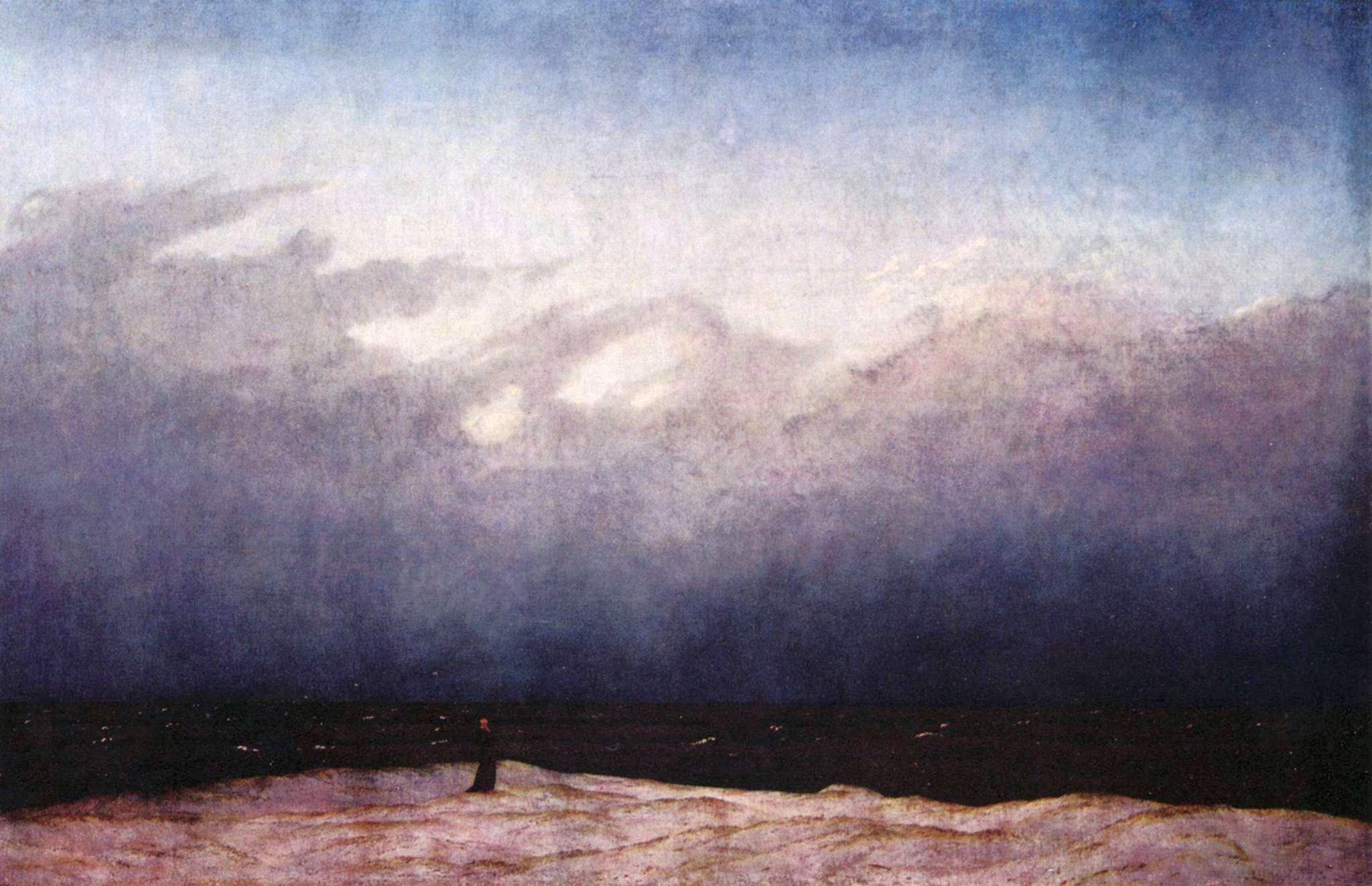
Take a look at Friedrich's painting Monk by the Sea. Most Art teachers will tell you it is the magnificence of Nature (and for Friedrich, that meant God) surrounding the insignificance of man. The dark colors and angry sky suggest power and sometimes indifference to the small soul on the beach. Much like Stephen Crane's "The Open Boat." But, if you look at it another way, isn't the magnificence of Nature including the man standing on the beach? We are included in that Greatness, that God created us as he created the sea, the sky, both dreadful and beautiful. As are we. Both dreadful and beautiful. Acts of both monsterous cruelty or benefinence. ***
Haven't you always wanted to rewrite movie scenes, ones where you just wonder what the character was thinking. Take My Girl for instance. Macauley Culkin's character was allergic to bees. If I remember correctly, he knew he was, had an epi-pen to undo allergic reactions. Yet there he was, away from home, walking through the forest, and he sees a hive-like object on the ground. So he kicks it..... and gets attacked. And now that scene lives on for eternity in movies. And some million years from now, citizens on Alpha Centauri will watch that scene and say, "What was he thinking!!!" ***
Quick Reviews: David Gray's Draw the Line. On the heal of Life in Slow Motion, it looks like David wanted to intigrate the Pro Tools synthesizers to live symphony recordings. And while I appreciated the albums by Matchbox Twenty that have been criticized for being overproduced. This album actually is badly overproduced. You can't hear the words all that well, although the lyrics are ingeniously done and very Dylanesque. He needs to take this album back to the simplicity of White Ladder and New Day at Midnight. Or, better yet, there is a live album he cut in 2007, called Thousand Miles Behind which pays amage* to folk singers that came before him. He covers songs by Tim Buckley, Bob Dylan, and others that I haven't discovered yet, but will. Excellent singing, amazing lyrics, and the instrumentals are good too. So find that one somehow (it's not in the Borders database....maybe online), and listen to it, even if you're not a David Gray fan or know who he is. Although, if you do get the new album, get the deluxe edition, because the second CD has a mix of live tracks and B-sides which are really good, especially "Babylon," his most famous song. ***
Where the Wild Things Are Soundtrack: It is what it is. It is sung by Karen O and the Kids, along with what a reviewer called "primitive folk music." It reminds me a lot of Sufjan Stevens style of folk. Pan flutes, piano, guitar, some with a modal melody (meaning, in Tom Leher's dictionary, that they play a wrong note every now and then), and the laughter of kids. It is the raucous melody of children playing on the playground, the screams and shouts, first annoying, then infiltrating towards something nostalgic and wonderful, that sparks our imagination. In short, the Soundtrack puts into sound what the book puts into words. And hopefully, what the film will put into a colorful and meaningful piece of art. To me, the film should not be just a children's flick, but something that reaches into the hearts of adults and finds what remnant of childhood each of us still has left.
 In the end, I would put this movie in the same category with Pay it Forward, A.I., Where the Wild Things Are, (all underrated movies that are some of my most favorite) which are movies about kids, but definitely not for kids. Disney's commercials for the movie on their own channel are actually misleading in how "supernatural" CJ Adams character actually is. In fact, he's just a normal kid, with leaves growing out of his legs.