Showing posts with label Caspar David Fredrich. Show all posts

Tuesday, April 15, 2014

Iron Heart

The problem with sucking on the teats of Dionysus is that, at a certain point, you don't know how to feel anymore.  Your heart turns numb, an anesthetic that creeps slowly up your chest until it enters the brain and you turn off, because there's nothing else to do.  There's no reason for it, none at all.  Apollo cannot enter the mind if it's been turned off already, and then there's no reasoning, no logic.  It doesn't surprise me that the teen who went on a stabbing spree doesn't remember doing any of it, or the mother who killed both her kids (admittedly, she was on alcohol and meds) doesn't remember it either. They can't remember if their minds have been turned off.  They have become robots of the Unmaker (as I've talked about before).  All emotional impulse, instant gratification, without thought of the consequences, a cut, a bleed, release the adrenaline and make it all feel better. It will all go away soon.  Except it won't.

I've seen so much recently, from the smiling news reporters who, story after staccato story, tell of the most horrific acts mankind has ever known, and then move on to weather and sports as if nothing has happened.  I'm surprised more news reporters haven't ended up in mental institutions, suffering from PTSD just by reporting on reality.  And kids want constant emotional turmoil, because the deafening silence of "nothing happening" is unbearable in today's world.  If nothing is going on, if Justin Bieber isn't constantly in the news, having done something, usually negative, because that gets more attention, then something is wrong.  The mug shots and tattoos and scantily clad pictures rotate around instant-grams and tweets and pictures that are as permanent as they are forgotten.  Today's shirtless pic is followed up by tomorrow's nude, because that's what the world wants.  Constant hormonal flow, without recourse of thought or reason.  Nothing that stops and watches the permanence of the rings forming in the trees, for our eyes are taken to the leaves blowing away, a flicker of movement, resulting in nothing.


Even in music, numbness is a feeling as prevalent as love.  It caused an entire movement (one that's not gone away, just experienced a brief glow in the spotlight) of forced emotion, trying to squeeze out every drop of emotion, the highs and the lows, out of anything. The opposite of emotion is not reason, but the absence of emotion, as there's nothing to fill that void.  Nietzsche would have quoted in this day and age "Apollo is Dead," and he'd be quite right.  Because if there's no thought behind feeling, no reasoning behind love, there's no point, is there? We could whip ourselves into an emotional frenzy, hurl ourselves off a metaphoric cliff, and there would be no notion of what was on the ground below.

It goes for Christianity, as well.  There's nothing more amazing than the emotional effect of God's word through a song. Listen to I Then Shall Live by the Gathier Vocal Band and Ernie Haase and Signature Sound, and not get goosebumps, I dare you.  It's so easy to get emotionally worked up in a service, as you sing chorus after chorus of a song, but it's got to have some meaning behind it.  For if (and I've seen this) you spend all Sunday School listening and singing to Praise & Worship songs, and are filled with emotional responses, and then leave without any Reason behind it, the glory fades until the next time. God wrote the Bible not just to express His love for us, but also to impart his wisdom. But some want the emotional support without the wisdom.  I think it's almost like a drug.  Go back and listen to the song linked above 50 times in a row (no, actually, don't do that), and the emotional effect will wear off. The words will be recessed into the back of your mind until they've lost the impact that they would have had before.  That's the problem with emotional highs... they never last.  But if there's Reason behind it, something that takes the emotion, stretches it out, analyzes it, applies it to your life, finds patterns and examples, the emotion sticks like super glue onto your life, and it lasts forever.  Because you've made it your own.

Anyone can work someone into an emotional frenzy.  Hitler did it, mass hysteria at the Salem Witch Trials is another example.  Keep the emotion going, so that you don't step back and think about what's really going on, and it'll be fine.  Except the Unmaker always wins that way.  When the emotions have become numb, and you have to find more and more extreme measures to make you feel anything, then the things which weren't even thinkable at one point suddenly become real.  Go on a shooting rampage in a school?  Sure, why not?  It releases feelings and hormones and tension... until the police are ready to shoot you, and then reality hits for one moment, until it's blacked out by the illogical step of shooting yourself.  The Unmaker is very willing to show you what you've done before he pushes you over the edge.

All this is why there has to be a balance between Apollo and Dionysus, between Reason and Emotion.   It's why, again, I have to return to Friedrich's painting "Wanderer Over a Sea of Fog", with the Traveller standing upon the peak of the mountain, shoulders calmly but firmly taught, head erect, confident in his stance, able to Think and Feel, and keep the balance between the two.  Without this, he would surely tumble over the edge to his death.

It's so very easy to just give in to the emotions that swirl constantly like the wind atop that mountain. So easy just to succumb to the breathtaking highs and depressed lows that our lives will inevitably bring us.  And in wanting those highs, constantly, we eliminate the opposite by taking medication, and we forsake Reason entirely.  It's dangerous, for those without Reason can be manipulated, and they stand atop the peaks without sure footing.  Without Apollo's guidance.... it's a long way down.


Wednesday, February 19, 2014

Making Music Under the Cypress Trees

Soon you will see a picture of the Encyclopedia next to the images of the BetaMax machine and the 1681 demise of the Dodo Bird.  We have several sets that people have donated to the Friends of the Library group here in Conyers, and we can't even give them away.  The reason, much like the decline of books, CDs, and Playboy magazine readers (yeah, for the sports, we know), is due to the Internet.  Wikipedia killed the Encyclopedia, and while teachers will probably never allow a Wiki reference in their research papers, it's essential to the education of kids nowadays (young whippersnappers). They can find any information they want on any subject, and it will probably be fairly accurate (and therein lies the rub).

I say this because I was remembering a painting from my college days, one that Dr. Viau and Dr. Pepetone had used in their Gothic Imagination class, and, as the years extend the tunnel further and further back, I couldn't remember the name or the artist.  So, off to the Internet I go.  It was a painting of someone rowing toward a large batch of cypress trees. So, on Google, I put "Rowing Art Cypress" and instantly, the picture of Arnold Böcklin's Isle of the Dead pops up, along with the link to the painting's article on Wikipedia.  I instantly found out what I needed to know, and learned something (again) in the process.  

Böcklin was a Swiss painter in the 19th century (1800's for those of you figuring in your head), and his style reminds me quite a bit of Caspar David Friedrich's paintings.  This, of course, comes as no surprise to me since I love Friedrich's works, and therefore this one was bound to stick in my head. Like Friedrich, Böcklin used symbolism heavily in his works, although his were more mythological in nature (while CDF used Christian imagery).  The painting mentioned above has a rower taking someone to this island filled with cypress trees, a symbol long associated with death.  The rower himself goes back to Charon, the one who would row Greeks to the hereafter, and the person standing in white, calmly looking toward the trees and the island, would be the person we would identify with. Notice how, like the Traveller, the individual stands facing away, confident that he or she will not fall while the rower rows. He (I'm a guy, it's a "he") looks toward death in a calm manner, just as the traveller does, looking out over the cliffs.   

Böcklin had a very intimate relationship with Death, as he lost 8 of his 14 children in infancy. I found it not surprising that The Isle of the Dead was painted late in his life, while perhaps he was facing his own mortality.  How do artists contemplate Death?  With the paintbrushes that have expressed their lives, of course.  And paintbrushes are metaphoric here, as the same thing applies to artists of all media.  Take a listen to Mahler's Ninth Symphony (his last) and watch the paintbrushes find dark, lonely tones, as an example.  

What interested me, as I listened to my mp3 player in the car, were the aging rockers of the 1960's, and how they are dealing with their own mortality. I've noticed on several albums by different singers tracks that deal with their own deaths, the silencing of that music.  They are haunting works, beautiful, leaving the singer exposed and vulnerable.  I really want to get to that blog, but this one had to come first.  So make sure you click on the links above and go learn some things.  We have Wikipedia here for a reason, to make up for all the education we've forgotten or never received in today's schools.  It's the one thing I refuse to do, to look back with regret, because going forward, there's so many things I can do, so much to learn and experience.  Like the traveller, it's best never to see yourself looking backwards in regret, but forward in anticipation.   

Tuesday, October 22, 2013

Climb Ev'ry Large Rock

Denzil Pugh is climbing a mountain. Why is he climbing a mountain? I've been walking trails for a year or so now, through the forests, through spider webs and around snakes and across rivers. The trails have taken me towards granite boulders that sit on the sides of hills, growing moss, collecting leaves. I've climbed hills and looked out over the next horizon and seen Stone Mountain in the distance. And the roads have curved through and exited Rockdale County into Dekalb, until my next walk took me to the Davidson-Arabia Mountain Nature Preserve The experience I had there, at the foot of the monadnocks (large, single rocks, like Stone Mountain), was similar to the beginning of my travels at the South Rockdale Community Park.  Coming out of the forest, following the path, I saw massive power lines stretching to the horizon.  Constructs of steel, electricity, power... how awesome it was, to see what man had built to run every aspects of our lives.  Reaching the end of the forest around Bradley Mountain (I parked at the southern end of the area, near the AWARE wildlife area, and followed the rock cairns), I saw a vast expanse of rock sloping upwards, many feet high, with those cairns like pimples spotting the landscape.  In the same way that man created the power lines, so did God create these monoliths of granite, providing evidence of His power, as well as his generosity.  The rock here, called Tidal Grey, is sought after for building countertops...etc...  It becomes the rock, the clay, as it were, that man creates his own world.  In a sense, he is emulating his Creator.  


So I climbed up Bradley Mountain, following the cairns, stopping frequently to catch my breath, as I'm not in the best of shape, but eventually, I reached the last cairn, and the top of the massive rock.  Having never been on top of a mountain before, it was a totally new experience.  Out across the horizon, I could see the tops of the skyscrapers in Atlanta, and Water Towers as reservoirs for the communities hidden in the trees.  The wind blew, and high above me, hawks or buzzards circled in currents high above the rock, looking for an easy meal.  I felt much like the Traveller in Caspar David Friedrich's  "A Traveller Upon a Sea of Mist." It gave me satisfaction, confidence.  I think climbing this mountain, or one like it, is something everyone should do, just to have the experience.  I will most definitely do it again. 

I tied two references to this blog at the top.  First, Mother Superior singing "Climb Every Mountain" from The Sound of Music, which combines the actual mountains of the Alps with the metaphors of life as a mountain.  And while I could go on for pages looking at this very obvious image, used by most every author that had a mountain in their works, I won't.  Because William Shatner did it so much better.  In his interview for Star Trek V, Shatner describes the second scene of the movie, which has Captain Kirk climbing a mountain in Yosemite National Park. He attempts a rationalization of the scene, using the mountain as metaphor, and does a great job of it, no
matter what the other people commenting on the Youtube video say.  It is man conquering nature, God, if you want to go that far (which, obviously, is the theme of that movie, with Kirk going to a world that housed "God," which turns out to be a malicious alien, which the Enterprise fires upon.)

However, I don't think the idea of climbing Bradley Mountain is analogous to destroying God. Rather, I think seeing nature in its full beauty at the top, in all its fragile wonderment, along with the sharp cuts of quarry work, carving out the stone to make the buildings we live in everyday, is a fitting relationship. We both use the stone and then let it stand.  I find the paradox in what I find beautiful about the mountain.  I've seen many pictures of the area--pictures of wildflowers, of the red moss that is unique to the rocks, of the pine trees growing strong and bold from cracks in the rocks themselves--and yes, that is all wonderful.  What I find aesthetically pleasing is the rock itself and what we have done to it and with it.  The cuts, the creations, the water carving out pools and snakes of black upon
slabs of gray.  Probably what I spent most time looking at was the square slab structure made at the far north side of Bradley Mountain on my latest walk around the trails.  Next to the fence that denotes still private property, there is a square structure of granite, solid, held together by metal bolts. Atop it, people have set smaller granite rocks, and on the back, a metal door, which I did not open.  I don't know what it was for, but it was probably made for quarry storage.  What would people, some tens of thousands of years from now, think of it when they find it in a probably now barren planet?  A shrine, a religious construct, an altar? To thank God for the rocks?  Who knows?

If you want to get more information about Arabian Mountain, especially the wildlife and plants, go to Kay's blog here.   She has walked the trails for much longer than I have, and has more knowledge of the ecology there.

I tried, before I left the top of that mountain, to stand as Friedrich's Traveller did, and feel as Howard Roark did at the beginning of Ayn Rand's The Fountainhead, seeing the hill he was standing on as both itself, the grand beauty of it, and as potential, what he could make of this beauty with his own hands.  We've been given this world by God to construct to glorify Him, but also to make Him proud, to emulate Him, to become creators ourselves.  Let us use this world in that manner, respectfully, adding beauty while preserving it. With reverence as we cut into the stone, with wonder that we are even here to see it.  Let us climb more mountains.

Sunday, January 6, 2013

Naming Snowflakes


Ah, January in Georgia! The beginning of abbreviated winters, short flirtations with frozen precipitation, and many hours of trying to find just where you put the ice scraper last spring.  For nothing is as shocking as trudging out to the car some cold morning and finding the car covered with ice. Maybe the windshield wipers will take it off, so you sit in a cold car for 10 minutes, hoping the defrosters and the scraping of rubber against an immovable glacier, will give you some small hole to peep out of.  Woe be to the squirrels that run in front of the car that morning.  Or there's the bucket of hot water method, which, while fun, watching the steam rise from the pavement, gambles upon the windshield suddenly cracking and becoming one irritating call to the Auto Insurance instead of actually going to work.  My mom's method is using a credit card, which, amazingly, works.  Might as well use them for something other than quick runs to Taco Bell.

Watching the weather reports on the news, any time they put that little snowflake on the 5-day forecast, I know, even if it's just a few flakes on the top of Georgia's mountains, people will, without fail, drain every grocery store of bread and milk, even if they've never used milk in anything except Macaroni & Cheese.  Sure, their are hills here that, if iced over, prevents anyone from going anywhere.  But there's no need to panic if you're educated.  Snow never hits the Atlanta area from low pressure fronts coming from the north.  Even wrap around snow, when cold air squeezes the moisture out of the atmosphere, will only melt on the ground.  The ideal setting for snow (just so you know) is to have a cold front come through, with the Low riding on the Northern Jet Stream, and then have a Low riding on the Sub-Tropical Jet Stream (it splits in Winter) come from the Gulf of Mexico right after it.  For Conyers, a Low coming up from around Macon will give us several inches of snow.  The "Storm of the Century" in 1993 is the most striking example of such a storm.


People need to read radar.  Generations before us didn't have such luxuries, to stay in the comforts of the their own homes and be able to tell which direction the wind was blowing.  My stepdad was much more adept and just going outside and looking and feeling.  But since we have the technology to monitor storm systems for so many hours before they hit, it's easy to interpret Doppler radar and infrared-enhanced cloud tops to see exactly where weather is, and where it is going.   Take the spring weather, when Tornadoes are likely to strike (at least in Oklahoma, where I was born).   Gary England was (and still is) able to read the radar and pinpoint where the tornado was going to touch down, even down to the block level (yeah, in Oklahoma, they have "blocks," not windy roads).  Here in Georgia, the tornado "warnings" they issue are done by the whole county.  It could miss you by miles, so it's best to know how to read Doppler radar and track weather systems yourself.  It helps my mom with knowing when to come home, so she doesn't drive in blinding rain down the interstate.  But it's also necessary, especially when in Oklahoma, to listen to the  Meteorologists, like Gary England, because they've been doing it for a lot longer than what we have.  As a kid, I wanted to be a Meteorologist, to report the awesome power of nature to the world.  My math grades weren't so good, so that didn't work.  When we first got cable, I loved watching The Weather Channel.  24 hours a day weather, with the Tropical Update at 50 minutes past the hour (more on that in a minute).  And, in the beginning, no commercials! It was a service brought to us by the wonderful weatherpeople in Atlanta.  Well, now it's filled with "Weather-themed" shows and movies, and 30 seconds of weather with 5 minutes of commercials.  Added to it that TWC is now owned by NBC, which is now owned by Comcast.  So now it's all about ratings and shows.  No Weather! On the Weather Channel!  So if I need to see the radar or the weather, I never go to the Weather Channel, I simply get on the Internet.  Now, even if Cable goes out, we have access to weather on cell phones and tablets, unlike my childhood, where, if the TVs went out and the rain and lightning and hail pounded down on the house, we were forced to get out a small, battery powered radio and turn it to a country station to hear Gary England's reports of severe weather.  It's no wonder that I associate the band Alabama and "Elvira" to stormy nights with no electricity.

Back to the present.  I turn on the Weather Channel, because there's nothing else on, and they are talking about a Nor'easter that is bringing snow and wind to New England.  They call it "Freyer." Huh????? I didn't know if that was some obscure weather term or what, so I looked it up.  Turns out that the folks at the Weather Channel, in a ploy to get ratings, and possibly a power draw from the NOAA and the National Weather Service, decided to start "naming" winter storms.  "Freyer" is supposedly the Norse God of fair weather (possibly where we get the word "fair".)  Absolutely ridiculous!! I understand the idea of Personifying weather phenomenon, as Hurricanes have names, and you have the idea of "Mother Nature."  I've tried to keep the personification of weather out of this blog, and it's been harder than you might think.  I've been complaining for a couple of years about naming every cloud in the Atlantic, under the suspicion it might have a low pressure area and some wind.  And now they want to name winter storms as well?  Of course, there are political reasons for doing this as well.  I've long maintained the idea that the NOAA names more and more storms in an effort to increase the number of life-threatening storms in the Atlantic, and therefore pressuring Congress into giving more money to the organization.  The same thing would make sense for naming winter storms, as it becomes an easy way to refer to a certain set of damages for insurance agencies, and for FEMA to attach a personality to a set of loans, making it easier to get funding from Congress.  Let's just say that there's no scientific reason for Personifying weather systems, especially cold fronts.   If we are going to do that, why don't we name tornadoes as well??  A simple letter and number will suffice.  We could name snowflakes, or individual clouds, and they could be tracked and identified in the skies.  Oh look, there's Cumulonimbus Cloud Audrey, floating over the city!  It sorta looks like a raccoon, doesn't it?

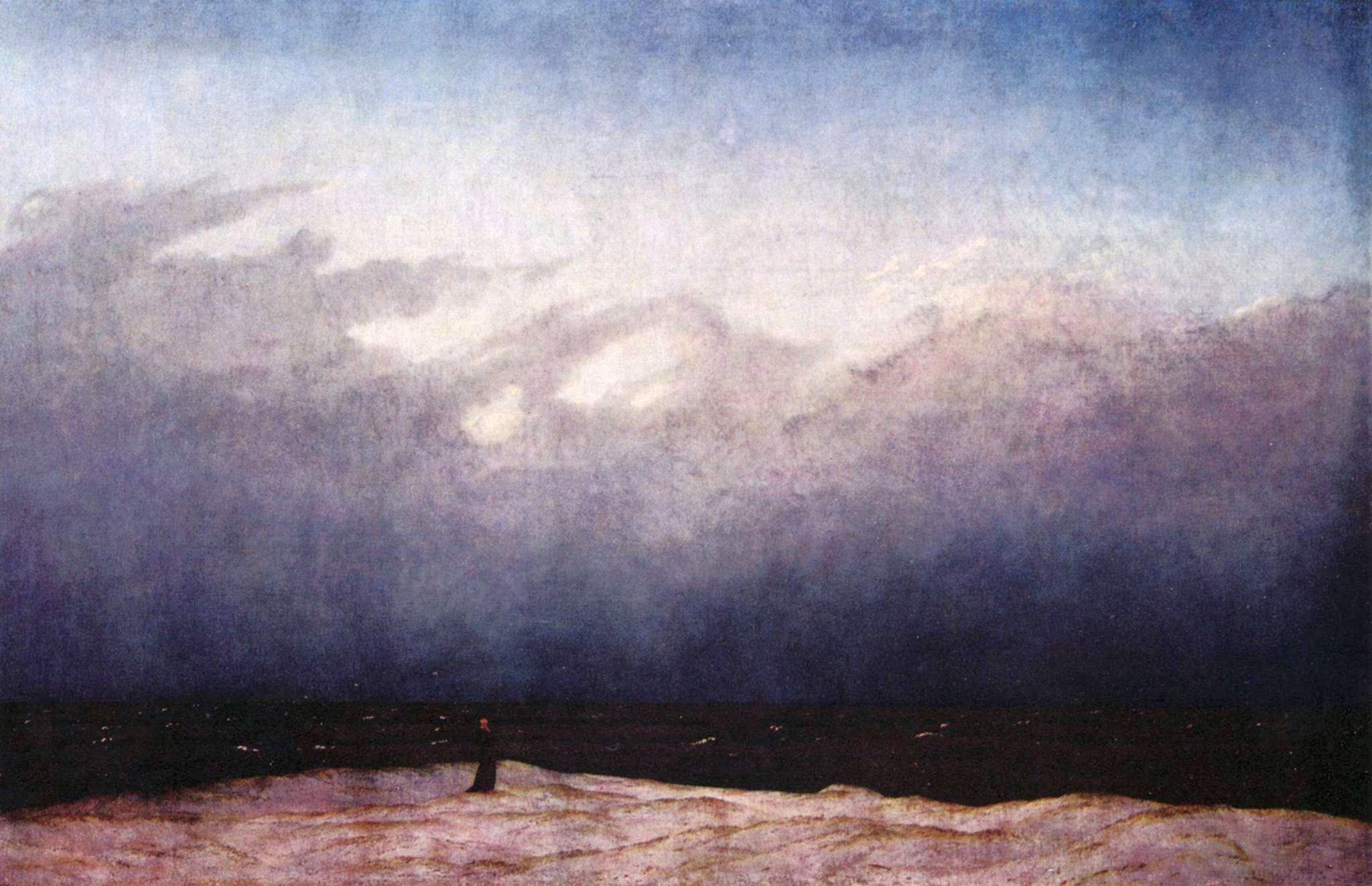
We cannot control the weather, nor can we fashion it into our own image, giving them names and personalities.  We cannot give Nature sentience, that's God's work.  We can simply gaze at the power of nature, wonder at the sheer awesomeness of the forces at work on this planet, and feel as the Monk did, standing on the  shoreline of the sea.

Monk By the Sea by Caspar David Friedrich

From our Back Deck, 2010.

Front Yard, Colorado Pine, 2010

Tuesday, October 6, 2009

Bouncy, Bouncy....

QT, Roly Poly, Monk By the Sea, David Gray, Where the Wild things Sing

Someday, when you're feeling low (oops, James Dean song), go to the QT and fix this excellent perk up. Go to the fountain drinks, and mix together some of the Rooster Boost Energy Drink (just a little, on the bottom for Strawberry Flavoring), then Dr Pepper, then add the Vanilla flavoring. Mix, Pay, and slurp.... sooooo good (what it does to your blood sugar is another story.)
***

I just went to the Roly Poly restaurant by Kroger on Ga 138 in Conyers, and got a sandwich (while waiting for my car to start, which it didn't.) wrap (philly cheese) and some of their potato salad. As one of my friends would say, OMG, you have to get some tater salad!!! It's amazing!!! I'm gonna go get a big container of it for $4.99.
***

Take a look at Friedrich's painting Monk by the Sea. Most Art teachers will tell you it is the magnificence of Nature (and for Friedrich, that meant God) surrounding the insignificance of man. The dark colors and angry sky suggest power and sometimes indifference to the small soul on the beach. Much like Stephen Crane's "The Open Boat." But, if you look at it another way, isn't the magnificence of Nature including the man standing on the beach? We are included in that Greatness, that God created us as he created the sea, the sky, both dreadful and beautiful. As are we. Both dreadful and beautiful. Acts of both monsterous cruelty or benefinence.
***

Haven't you always wanted to rewrite movie scenes, ones where you just wonder what the character was thinking. Take My Girl for instance. Macauley Culkin's character was allergic to bees. If I remember correctly, he knew he was, had an epi-pen to undo allergic reactions. Yet there he was, away from home, walking through the forest, and he sees a hive-like object on the ground. So he kicks it..... and gets attacked. And now that scene lives on for eternity in movies. And some million years from now, citizens on Alpha Centauri will watch that scene and say, "What was he thinking!!!"
***

Quick Reviews: David Gray's Draw the Line. On the heal of Life in Slow Motion, it looks like David wanted to intigrate the Pro Tools synthesizers to live symphony recordings. And while I appreciated the albums by Matchbox Twenty that have been criticized for being overproduced. This album actually is badly overproduced. You can't hear the words all that well, although the lyrics are ingeniously done and very Dylanesque. He needs to take this album back to the simplicity of White Ladder and New Day at Midnight. Or, better yet, there is a live album he cut in 2007, called Thousand Miles Behind which pays amage* to folk singers that came before him. He covers songs by Tim Buckley, Bob Dylan, and others that I haven't discovered yet, but will. Excellent singing, amazing lyrics, and the instrumentals are good too. So find that one somehow (it's not in the Borders database....maybe online), and listen to it, even if you're not a David Gray fan or know who he is. Although, if you do get the new album, get the deluxe edition, because the second CD has a mix of live tracks and B-sides which are really good, especially "Babylon," his most famous song.
***

Where the Wild Things Are Soundtrack: It is what it is. It is sung by Karen O and the Kids, along with what a reviewer called "primitive folk music." It reminds me a lot of Sufjan Stevens style of folk. Pan flutes, piano, guitar, some with a modal melody (meaning, in Tom Leher's dictionary, that they play a wrong note every now and then), and the laughter of kids. It is the raucous melody of children playing on the playground, the screams and shouts, first annoying, then infiltrating towards something nostalgic and wonderful, that sparks our imagination. In short, the Soundtrack puts into sound what the book puts into words. And hopefully, what the film will put into a colorful and meaningful piece of art. To me, the film should not be just a children's flick, but something that reaches into the hearts of adults and finds what remnant of childhood each of us still has left.