Now anyone that says "White Chocolate Oreos" would immediately start salivating, and one would think that I would too. White Chocolate, I am convinced, is what God sent down to the Israelites for Mana. So when I had a little extra cash, I went out and bought me a box of White Chocolate covered Oreos and took them home to the apartment I lived in at the time (2000, I think.) One of the essential properties of the Oreo is its dunkability. In fact, the true glorious flavor of the Oreo only appears once it is almost saturated with milk. It is this fact that made me react in dismay and horror when I realized that, because of the White Chocolate covering, the Oreos I had bought couldn't be dunked!!. They were useless to me, and being thus dismayed, I did dispose of the vile food posthaste. It is one of the rules of the Oreo that it must be dunked in Milk, and so if I can't do that, it isn't an Oreo, and therefore, is of no use to me.
***
Stonecrest Mall, now adorned for Christmas, is ready for the throngs of people that will venture down its hallways, with the walls echoing the screaming children who think that leaving every store must be accompanied by him or her getting a toy or candy or whatever. But this I have ranted about for years. And as they ascend the escalators from the bottom floor, they will see that the rungs are not black, but orange, and there are advertisements of AT&T wireless cell phone plans covering escalators.
They will put advertisements on anything nowadays. The 1st and 10 lines on football shows, they sell commercial space on pregnant women's stomachs, etc... and it's a good thing, I guess, although how you would have commercials constantly bombarding you and have it make any impact whatsoever. But it does, in some cerebral way. So lets put advertisements on everything... star cases, light poles, walls, toilet seats (this toilet was brought to you by Scotts Toilet Paper!!!!), Airbags (by Allstate!), you could even have bullets have the names of local Funeral Homes! Hey, it would be effective, wouldn't it?
***
I want to lament the recent downfall of Sting's career as a singer. Sting's past albums have been a mix of amazing songwriting and performing (Soul Cages, Brand New Day) and banal albums of pop nothingness (Mercury Falling, Sacred Love). His live performance on 9/11, entitled All this Time, was a brilliant mix of Jazz and pop, and should have been followed with a Jazz album that would have been wonderful. But, alas, this is Sting, who has decided that medeval bard singing is where he wants to go. The latest "Winter" album has a couple of good tracks ("Soul Cake", for one, based on "A'Soulin'" by Paul Stookey of PPM fame), but the rest are performances of old English folk songs droned into a mic for no other audience but himself. And that's okay, I guess, since he has the money and can release albums however he wants to. And he is a performer, and an artist, and can create what he feels he should, but it would be nice to hear the complex lyrics and compositions that made Sting a constant on my Mp3 player.
Sunday, November 29, 2009

Thursday, November 19, 2009
Reviews: Maze Runner, Bill Gaither in a Box.
The Maze Runner, by James Dashner, gave me the impression that I was in the middle of a web, with all these other books and authors, all well known and famous for contributions to literature, surrounding Dashner's work. And this from an author who graduated from Duluth High school here in Georgia and is currently writing this second series. He also has written The Thirteenth Reality, which I will be sure and investigate. The book itself deals with a boy, Thomas, who regains consciousness and finds himself in a box with these other boys, who live, eat, and sleep, all to solve the mystery of the gigantic maze around them. Watching Thomas grow in the story reminded me of Bilbo, in The Hobbit, as he finds the talents and maturity he needs to become an essential part of the tale.
Dashner has a great, staccato writing style that fits in with the teenagers that fill the story. The timing is acceptable, for the most part, except at the very end, where the last chapters are rushed, almost as if there was a page limit for the book. I've always felt that there comes a moment in a book where you have to look around and sigh at a place where the protagonist is content with his world, and so are you. It's a place you don't want to leave, but yet, if you didn't, there wouldn't be a story. It's much like life. If you are in a content place all your life, you don't really have one. And any biography you might write wouldn't sell a copy. I sort of wish that Dashner had prolonged this part of the tale just a bit, so that we might languish in his world.
I kept thinking about Gary Paulsen's The Transall Saga at this point, watching Thomas evolve into a skilled hunter and survivor. And Paulsen does let the reader stay in a place for a little while before moving on. Also, and this is said in other reviews, the fight of a sustained group of boys trying to establish a culture, a system of governance, is much like Golding's Lord of the Flies. Except for these prisioners, the island has a purpose, as Thomas finds out. One of the characters, Chuck, reminds me of Piggy, as well.
But the main novel I thought about as I read it was Orson Scott Card's Ender's Game. If you enjoy reading Card, then this is a great read. I'm only giving it 4 stars (of 5) because the ending was rushed, and I didn't agree with some of the plot line. But as it is a series, the next book should resolve some of my issues with it.
***
Gaither Vocal Band Concert, Augusta, GA.
I put in Augusta, because it's a very large part of the journey. I don't think I ever said how much I hate driving. It's almost an unbearable task, one that is necessary because you can't get anywhere without doing it. And Augusta is 2 hours from Conyers, down a long, straight, boring road, with nothing but trees to look at and Police cars to watch out for. And that was what save me from going to sleep (I can easily go to sleep just driving to the grocery store, especially not without music or talk radio or an audiobook or something. I have to keep that corner of my brain occupied, or, if it becomes bored, it'll find the nearest place to activate itself, namely, in my dreams, which it tries to accomplish by putting me asleep.). Because we hadn't looked at the tickets until after we had left, and it was an hour and a half to the start of the concert. So I concentrated on going as fast as I could while watching for signs of Crown Vics with lights on top. :) And to tell you the truth, going 90 down the interstate feels pretty good. Gets the adrenaline pumping.
The James Brown Arena (formerly the Augusta-Richmond County Civic center) was built in 1974, in a time when domed stadiums and arenas were built to withstand massive hurricanes and were made as boxed-like as possible. Therefore, the arena was one big box with seats almost vertically to the ceiling. Did I mention how much I hate stairs? It reminds me of the Superdome in New Orleans, but shrunk in the wash. At least the Georgia Dome is comfortable.
I've been to many Gaither Concerts in my days with my mom. My job is to drive to/from the place, and be the photographer. I take pictures of my Mom and _____. Then we get the pictures developed and then signed the next time we go to a concert. The music is good, for the most parts, and it's easy to know when to take potty breaks. Some groups are better than others.
The one thing that struck me as interesting this trip were the people around us. Augustians sitting near us had never been to a Gaither Homecoming concert before. They were mainly older folks, with the unmistakable look of being country people for most of their lives, and their parents' lives as well. And that's okay, for the friendliness and devotion to God is very prevalent in the audience. (As a side note, the people at the Arena need to hire better ushers. It certainly helps if they are literate, and not half blind.)
It got me to wondering. Where are the young fans of Southern Gospel music? When the youth of today pass on their musical heritage, will it only be the music of Madonna, U2, and MC Hammer that they remember? Will folk music die out all together, with no one humming "Leavin' on a Jet Plane" some thirty years from now, when Mary Travers is but an entry on Wikipedia? The honest answer is, I'm not sure.
I do know, however, that groups like Ernie Haase & Signature Sound and the Gaither Vocal band are doing their best to promote traditional Southern Gospel music to today's generation. And it's working. Among the people performing on the stage that night was a boy singer named Logan Smith. His Myspace page says he's from Covington, and enjoys Southern Gospel music to the extent that he can sing most any song in the canon. He has traveled with the Gaither group on the Alaskan Cruise, and sings at many churches here in Georgia. His favorite songs are those sung by the late Vestal and Howard Goodman. He sounds just like them, even better than my impressions of them. I was impressed. It also showed that Southern Gospel music has the ability to attract those of the younger generations, and thereby seccuring the genre to a healthy following in years to come. Now if only Folk music could find such saviors.
One of the Gaither Vocal Band's greatest songs is "I Then Shall Live," which was written by Gloria Gaither to the tune of "Finlandia," (done by Jean Sibelius, a Finnish Nationalist). As great as "Amazing Grace" is, it never ceases to amaze me how much Christians define themselves as "wretched." Pride becomes a deadly sin. There's no need for us to whip ourselves with cat-o-nine tails as punishment for sins that we have already been forgiven for. In Gloria Gaither's lyrics, she paints a Christian as one who, having been forgiven, can now live a proud life of one who knows the virtuous ways of living and celebrates that by spreading that joy to other people. It's a remarkable song, and one that the GVB and EH&SS do as an anthem to the positive force that Christians can do for this world, if they are not bogged down in political power grabs, hypocrisy, and bringing about condemnation to the people of this world whom they are supposed to love and support.
Dashner has a great, staccato writing style that fits in with the teenagers that fill the story. The timing is acceptable, for the most part, except at the very end, where the last chapters are rushed, almost as if there was a page limit for the book. I've always felt that there comes a moment in a book where you have to look around and sigh at a place where the protagonist is content with his world, and so are you. It's a place you don't want to leave, but yet, if you didn't, there wouldn't be a story. It's much like life. If you are in a content place all your life, you don't really have one. And any biography you might write wouldn't sell a copy. I sort of wish that Dashner had prolonged this part of the tale just a bit, so that we might languish in his world.
I kept thinking about Gary Paulsen's The Transall Saga at this point, watching Thomas evolve into a skilled hunter and survivor. And Paulsen does let the reader stay in a place for a little while before moving on. Also, and this is said in other reviews, the fight of a sustained group of boys trying to establish a culture, a system of governance, is much like Golding's Lord of the Flies. Except for these prisioners, the island has a purpose, as Thomas finds out. One of the characters, Chuck, reminds me of Piggy, as well.
But the main novel I thought about as I read it was Orson Scott Card's Ender's Game. If you enjoy reading Card, then this is a great read. I'm only giving it 4 stars (of 5) because the ending was rushed, and I didn't agree with some of the plot line. But as it is a series, the next book should resolve some of my issues with it.
***
Gaither Vocal Band Concert, Augusta, GA.
I put in Augusta, because it's a very large part of the journey. I don't think I ever said how much I hate driving. It's almost an unbearable task, one that is necessary because you can't get anywhere without doing it. And Augusta is 2 hours from Conyers, down a long, straight, boring road, with nothing but trees to look at and Police cars to watch out for. And that was what save me from going to sleep (I can easily go to sleep just driving to the grocery store, especially not without music or talk radio or an audiobook or something. I have to keep that corner of my brain occupied, or, if it becomes bored, it'll find the nearest place to activate itself, namely, in my dreams, which it tries to accomplish by putting me asleep.). Because we hadn't looked at the tickets until after we had left, and it was an hour and a half to the start of the concert. So I concentrated on going as fast as I could while watching for signs of Crown Vics with lights on top. :) And to tell you the truth, going 90 down the interstate feels pretty good. Gets the adrenaline pumping.
The James Brown Arena (formerly the Augusta-Richmond County Civic center) was built in 1974, in a time when domed stadiums and arenas were built to withstand massive hurricanes and were made as boxed-like as possible. Therefore, the arena was one big box with seats almost vertically to the ceiling. Did I mention how much I hate stairs? It reminds me of the Superdome in New Orleans, but shrunk in the wash. At least the Georgia Dome is comfortable.
I've been to many Gaither Concerts in my days with my mom. My job is to drive to/from the place, and be the photographer. I take pictures of my Mom and _____. Then we get the pictures developed and then signed the next time we go to a concert. The music is good, for the most parts, and it's easy to know when to take potty breaks. Some groups are better than others.
The one thing that struck me as interesting this trip were the people around us. Augustians sitting near us had never been to a Gaither Homecoming concert before. They were mainly older folks, with the unmistakable look of being country people for most of their lives, and their parents' lives as well. And that's okay, for the friendliness and devotion to God is very prevalent in the audience. (As a side note, the people at the Arena need to hire better ushers. It certainly helps if they are literate, and not half blind.)
It got me to wondering. Where are the young fans of Southern Gospel music? When the youth of today pass on their musical heritage, will it only be the music of Madonna, U2, and MC Hammer that they remember? Will folk music die out all together, with no one humming "Leavin' on a Jet Plane" some thirty years from now, when Mary Travers is but an entry on Wikipedia? The honest answer is, I'm not sure.
I do know, however, that groups like Ernie Haase & Signature Sound and the Gaither Vocal band are doing their best to promote traditional Southern Gospel music to today's generation. And it's working. Among the people performing on the stage that night was a boy singer named Logan Smith. His Myspace page says he's from Covington, and enjoys Southern Gospel music to the extent that he can sing most any song in the canon. He has traveled with the Gaither group on the Alaskan Cruise, and sings at many churches here in Georgia. His favorite songs are those sung by the late Vestal and Howard Goodman. He sounds just like them, even better than my impressions of them. I was impressed. It also showed that Southern Gospel music has the ability to attract those of the younger generations, and thereby seccuring the genre to a healthy following in years to come. Now if only Folk music could find such saviors.
One of the Gaither Vocal Band's greatest songs is "I Then Shall Live," which was written by Gloria Gaither to the tune of "Finlandia," (done by Jean Sibelius, a Finnish Nationalist). As great as "Amazing Grace" is, it never ceases to amaze me how much Christians define themselves as "wretched." Pride becomes a deadly sin. There's no need for us to whip ourselves with cat-o-nine tails as punishment for sins that we have already been forgiven for. In Gloria Gaither's lyrics, she paints a Christian as one who, having been forgiven, can now live a proud life of one who knows the virtuous ways of living and celebrates that by spreading that joy to other people. It's a remarkable song, and one that the GVB and EH&SS do as an anthem to the positive force that Christians can do for this world, if they are not bogged down in political power grabs, hypocrisy, and bringing about condemnation to the people of this world whom they are supposed to love and support.
Sunday, November 8, 2009
Trick or Treating, Purgatory, and the Gates of Hell
"What's it gonna be, Pops. The candy, or your front window?" Paul Stookey spoke those words in the 1960's, and they still ring true today. I've had friends on the social sites complain about the reactions that they had with children going "trick or treating" through their neighborhoods. Complaining about the amount of candy, "only one?!?," or even having the parents do the trick or treating for the children (who probably remain safe and sound in the car, away from the evil grips of all the child molesters that live in every house.) The spirit of Halloween has been completely dispersed from the holiday itself. It's been replaced, much as it has at the Yuletide season, with commercialism, greed, and a sense of "entitlement."
We are playing a CD on the overhead system this week, Sting's If On a Winter's Night, and track 2 is called "Soul Cake." That track, called "A'Soulin," is also on the Peter, Paul, and Mary album. The idea of Trick or Treating, from amongst other cultural traditions, comes from the Great Britain celebration of A'Soulin' on All Soul's Day, November 1st. On that night, the children go around, singing the song the PP&M performed, and ask for fruit, bread, candy, coins...whatever, as homage to ancestors, loved ones, that have passed on and entered Purgatory. Each eaten "Soul Cake," a bread specifically for that day, represents a loved one leaving Purgatory and entering Heaven.
So trick or treating, at least, through this cultural origin, is a religious ritual. The candy represents lost loved ones. Yet in this country, Halloween is just an excuse to get sweets. To feed hyper children and then send them to school the next day to drive the teachers nuts, or to let the blood sugar rise and drop and then they sleep the whole day. Whichever. But the problem is that children now feel that they are "supposed" to get candy on that night. That anyone who doesn't give you candy, or in enough quality, that you have someone insulted them. They have this feeling of "entitlement." And, it's the same feeling of entitlement that kids feel when they go to Walmart and feel they have to get a toy. Or later, when they grow up, the feeling of entitlement that they have to have Health Care. As for me, I would much rather get a job, go the store, and get my own bag of candy.
***
Book Review: John Connolly's Gates
This is a book that tries to be for young adults what The Book of Lost Things was for adults. But it doesn't quite reach the character development or the lyricism of Connolly's first fantasy work. It reminds me quite a bit of the Lemony Snicket books, in that it sounds as if an adult book writer is trying to write for kids, giving them a wink wink sarcasm while talking down to them.
Overall, the characters are agreeable, the flow works, and it was a decent read.
The plus I will give him is that he went into Quantum and String Theory quite well, and fused science (the multiverse) with religion (the idea that Hell actually exists in a Multiverse dimension.). The combination of the two will enthrall and challenge readers to think of the two in a totally different way, and will wind up being talked about in Sunday School classes, at least, I hope. It is a perfect spring board for someone to begin finding out for themselves about God and Science...etc...
I hope that, in the next book, he does the same for Heaven, since the book leaves that part out. If Connolly personifies Satan in this book, he cannot leave out the personification of his opposite. And there are plenty of characters in that world, Angels, for instance, that can make a Nurd like character, and work very palpably.
We are playing a CD on the overhead system this week, Sting's If On a Winter's Night, and track 2 is called "Soul Cake." That track, called "A'Soulin," is also on the Peter, Paul, and Mary album. The idea of Trick or Treating, from amongst other cultural traditions, comes from the Great Britain celebration of A'Soulin' on All Soul's Day, November 1st. On that night, the children go around, singing the song the PP&M performed, and ask for fruit, bread, candy, coins...whatever, as homage to ancestors, loved ones, that have passed on and entered Purgatory. Each eaten "Soul Cake," a bread specifically for that day, represents a loved one leaving Purgatory and entering Heaven.
So trick or treating, at least, through this cultural origin, is a religious ritual. The candy represents lost loved ones. Yet in this country, Halloween is just an excuse to get sweets. To feed hyper children and then send them to school the next day to drive the teachers nuts, or to let the blood sugar rise and drop and then they sleep the whole day. Whichever. But the problem is that children now feel that they are "supposed" to get candy on that night. That anyone who doesn't give you candy, or in enough quality, that you have someone insulted them. They have this feeling of "entitlement." And, it's the same feeling of entitlement that kids feel when they go to Walmart and feel they have to get a toy. Or later, when they grow up, the feeling of entitlement that they have to have Health Care. As for me, I would much rather get a job, go the store, and get my own bag of candy.
***
Book Review: John Connolly's Gates
This is a book that tries to be for young adults what The Book of Lost Things was for adults. But it doesn't quite reach the character development or the lyricism of Connolly's first fantasy work. It reminds me quite a bit of the Lemony Snicket books, in that it sounds as if an adult book writer is trying to write for kids, giving them a wink wink sarcasm while talking down to them.
Overall, the characters are agreeable, the flow works, and it was a decent read.
The plus I will give him is that he went into Quantum and String Theory quite well, and fused science (the multiverse) with religion (the idea that Hell actually exists in a Multiverse dimension.). The combination of the two will enthrall and challenge readers to think of the two in a totally different way, and will wind up being talked about in Sunday School classes, at least, I hope. It is a perfect spring board for someone to begin finding out for themselves about God and Science...etc...
I hope that, in the next book, he does the same for Heaven, since the book leaves that part out. If Connolly personifies Satan in this book, he cannot leave out the personification of his opposite. And there are plenty of characters in that world, Angels, for instance, that can make a Nurd like character, and work very palpably.
Tuesday, October 20, 2009
Movie Review: Where the Wild Things Are
I have never been so grateful that my grandmother (my mom's mom, who lives with us now) sewed blankets as a pastime. For those blankets became the rooftops for the forts we would build. All over the living room, using the footstool and the recliners and the divans (sofas) for walls. Or the time when Chris and Brad spend the night and we built a fort all throughout our basement and going up the stairs. It's this type of fantasy worlds which tie in Sendak's book with the current movie, along with all the fantasies, terrible and comforting, that reside in our minds.
So as I said in the review of the soundtrack (which is almost vital that you get prior to watching the movie), it is what it is. Meaning, Wild Things is nothing less than a portrait of all the fantasy worlds and dreams and nightmares that exist in our heads. That, mixed with the rage of injustice, the wildness of the subconscious mind, the desire to be something more or less than human, since humans do so many things that are unjust, cruel, and wrong. Wild Things is the quest to bring Love to a world where it doesn't always survive. Where, for most people, there never is a happy ending. For those that understand, Wild Things becomes a mirror into our own subconscious minds, where monsters lurk and become nightmares, or where the core things that make us all human, good or bad, reside.
To give a simple plot review for this movie would not do it justice, this masterpiece of art sewen into a medium which would give it the most life. It was an experience for me which showed me things about myself I hadn't realized. Let me share.
The movie theatre was dark, and I was there, basically alone. I could interact with the film however I wanted, so I sang with the soundtrack, whistling and humming whenever necessary, as I watched the journey of Max (Max Records) from reality to fantasy and back. I cried at the end, something I've only done once before, Pay It Forward, back in 1999. Which, by the way, also received the same critical ambiguity that Wild Things did, for the same reasons, but more on that later.
I walked out of the theatre to the cold, windy afternoon, and walked through the mall to my car, and I became painfully aware of the jacket I had on, the black one with the Autobot symbol on it. I had been, and still am, the child Max with the Wolf costume on. But in my generation, it wasn't monsters and folk tales that I had been familiar with, drawn power from, but Transformers. Max received a false sense of security, of power, in the costume of a Wolf, with teeth, and claws, and howls. So did I, believing that if in a world where Optimus Prime lived, it would be safe. So on the playgrounds of my elementary school, I was a Transformer (or Thundercat, depending), and I had the power to save the world, to keep away bullies, to be more than myself. I wasn't just a boy. This is the exact parallel that Wild Things hopes to achieve. The blurring of fantasy and reality is all around us, whether as children, or as adults.
And that's a good thing. If you take a look at the reviews in other places, you'll find that they are either lauding a masterpiece, or offended that it wasn't a "kid's movie" and that Max should be sent to some sort of child psychiatrist, or something. From this, you can see which people took the movie in, made it a part of themselves, realized how personal a film it actually is. Those others, who have lost their childhoods and only cared about if it entertained the little ones for an hour or two while they went about their own lives, they are the ones that protested that it wasn't a children's movie. Well guess what, they're right. It's not. At least, not for them. But for those of us who are children still, with that glowing essence of innocence and childhood still left in our hearts, it was a wonderful, horrifying, transcending work that left us, for a moment, aware of the fantasy world, and how mixed up the real world is.
For those that loved the movie, try John Connolly's Book of Lost Things, which achieves the same special qualities that Wild Things does.
Will Max hang up his wolf costume, not make believe in forts and animals and whatnot? Of course not. He will just know why he does it. I will too.
Tuesday, October 13, 2009
Days at Arbuckle Lake
The camera of the eye is a truly remarkable machine. With each blink of the eyelid, we record the moments of our lives. It is burned on the film rolls that are stored in our heads, for us to relive in our dreams and nightmares, to pull up that unexpected flash of emotion at the smell of cherry pie or the sound of an ice cream truck. Because our films not only have pictures, but sights and smells and tastes and perceptions, both imaginary and real. Does the garden become more real as we remember it? Does the smell of the rose become more than just that as the references in our minds mingle with the recording of the encounter? Does a priori knowledge make what we've seen more or less real?
Honestly, I don't know, don't pretend to know. I've never pretended that my memories were anything more than what they were. My dreams are always just that, with certain obvious symbols that portray emotions, and the like. But sometimes, a dream is just a dream, and no amount of interpretation will make it anything else.
But we all have our memories, and although they fade and become scratched as time travels on, leaving them as faded as the oldest recordings on my VHS tapes, we still can remember them. By writing them down. By telling them to people who care (or don't). The stories that our elders have of days gone by. If only they were recorded for future historians and authors to hold in their hands, and cuddle them as soft lambskin. When people walk through the empty town of De Pew, Oklahoma, after all the people have died or moved out, leaving the town center abandoned and empty, what will they feel moving through their bones? The bike racks are empty, the lampposts with a lingering staple or two from advertisements of yard sales and the latest soap guaranteed to get your clothes sparkly white, dark as the night sets in. The bricks stand, waiting for the tornado that will assuredly knock them down. But for that time, the town still stands, and when, then, will you hear the laughter of children running down Main Street? Or the old men in short shirtsleeves arguing about the latest baseball game. Those sounds are somehow still there, locked in our heads. We know them, but they fade, as if in translucent shimmers rising up from some outlying farm where the chimney is still on, and an old farmer sits, waiting for the sun to set.
We all have memories like this. At least, I hope we do. I shudder to think what the world would be like if our children, growing up in metropolises and skyscrapers and video games violent and magical, what they will remember as they grow older and look back at their childhoods. Where are the magical places in their lives, where nostalgia takes root and grows and protects the inner memories of our younger days? I pray that someone will take them out to the country, if even for a few days, and show them the soil and the water in the rivers and the squirrels running to their nests. And the old people in rocking chairs and the gravel roads with grass growing in the middle, where tires have never tread. And the stars.... the children of our world will never see the stars. Orion will be dimmed, his sword, and the great nebulae within, left forgotten.
But I am glad that I have such memories. My grandparents, those that lived in Oklahoma City and have since passed on, had in their plans a lakehouse down in Sulphur, Oklahoma, where they would spend their days off. It was a magnificent house, built with a deck around the whole of the house (much of which I saw constructed by my dad, grandfather, and other friends as saw fit to help.) I saw the concrete poured, the metal supports lifted up, the wooden beams nailed together and secured onto the house. And on cool, crisp mornings, with the wind coming off the lake, I would go out and sit on the deck and drink orange juice. It was best in the mornings, when the wasps were still asleep. I was afraid of wasps.
Driving down to Sulphur from Oklahoma City was always an adventure. I created a game to pass my time on the road, namely, to find each one of the letters of the Alphabet on road signs and permanent housings. No license plates. I was always glad there was a Western Sizzlin' along the way, and I knew where there was a small sign that had a 'Q' on it if I hadn't found it yet. The hour drive through the small towns of Oklahoma, the signs saying Pauls Valley, Paoli, Davis, and the counties, marked off the minutes till we got to Sulphur and the Lake house. The curvy road from the main highway to the lake itself seemed to take forever. But soon there were gravel roads that connected A frames and Mobile homes to the real world, and the trees encroached upon society and occasionally you would hear the scrunchings of tarantulas as they tried to cross the road to the next field. Our lakehouse sat at the end of a cul-de-sac, with us owning all the land around it. Open the gate, and the red house stood on the left, and the boat house on the right, where the sand pit and gravel pit stood for us to make endless forts and imaginary places with. The boat house was usually filled with wasps, and so I never went in there.
The house itself was filled with the knickknacks of my grandmother, who collected antiques from her family who lived in the area, and it had a life all to itself. My grandfather's bedroom was blue, with a stand of DIY how-to books on one side, and an ancient black and white TV in it that didn't work. On top of it was a globe procured in the 40s or 50s, when most of Africa was owned by foreign powers. I suspect it was my dad's globe. My grandmother's bedroom was pure pink, with a armoire and a stool that my grandmother sat on to put on makeup. And it spun around and around and around and I got dizzy spinning around on it. I have a picture of me doing that, and I'll post it here when I can find it. And beyond the deck, a path that lead down into the forest, down to the lake where a small beach was that we could go and swim a little, or throw rocks, since the actual beach was at the end of the windy road.
If you take a look at a map, Sulphur, Oklahoma is next to the Lake of the Arbuckles, a small hilly region in southern Oklahoma. The town is called Sulphur because the rocks in the area, and the natural minerals in the ground make the water coming from the cold springs near the town smell like sulfur. They even have a fountain where you can go and drink it. The minerals in the water are supposed to be very nutritious. The park used to be called PLATT National Park, and was the smallest National park in the nation. But since it was so small, it was turned into the Chickasaw National Recreational Area, demoted as Pluto was recently. The nature center sat atop the spring-fed river, and it was definitely cold water. We'd go out from the nature center and, already having our swim suits on, take our shirts off and go play in the frigid water beside the center. the river ran through the park and into the lake, where the water was warm as bath water some summers. The beach was made as water ran over the road when the reservoir was made, with sand poured on top of the edge, so if you dug below the sand, you could easily find pieces of asphalt, which was great for skipping rocks in the water. The park is still there, and one day I'll go back and visit.
The reason I bring all this up, at this time, is that I discovered something wonderful recently that made me think about my experiences at the lake house, and I wanted to record it, so happy did my discovery make me. You see, if you pull up the property charts for the original designs for the lake house, you'll see it sits on a road that has a name. I forgot what it was called, and no one would know unless they went and looked at the original plans. Well, one day, as a we were walking down the gravel road to the main one, we got to the end of the road, where the doberman pincers live (and they loved chasing you), and we noticed there was no road sign. Now, I loved looking at maps and knowing where every road in Oklahoma City went (ask my mom, I asked her a million times where each road went... :) ) So the idea popped into my head, "We need a road sign here!" I was probably 7 or 8 at the time.
So names....what do we call this street we live on? The neighborhood where my house was had names of English towns. One of my classmates, Stewart, in elementary school, his dad built neighborhoods from nothing and he named a bunch of streets after his children and family. Denzil Road would have sent chills down my Grandfather's spine (his middle name was Denzil, and he hated the name). So what to call it..... well, the road was made of rocks, so.... Rock Road.... or more precisely, Rock Drive, because the other is an ice cream flavor.
My dad got out his tools, his mountain wood saw and some yellow paint (it had to be yellow!) and we cut an arrow out of wood, pointing the way. It was one of the few positive memories I had of my father, when he was in his garage making things. We painted it and put with large letter stencils, "ROCK DR" on it. Then came the weekend and we went down there, walked to the end of the gravel street, and nailed the sign a prominent tree.
I'd give anything to have inherited that property, as it had been laid out in my grandmother's will. But life being what it is, and after my grandfather died Mema (what I called her) couldn't take care of two houses by herself. So she put it up for sale, and some doctors from Oklahoma City came down and bought it.
Fast forward... Mema died a few years back, and her house was left to ruin. But leave it to technology today to bring windows of the past into our living rooms. It is almost taken from pages of science fiction books, like Asimov, or Arthur C. Clarke. One in particular, The Light of Other Days, is amazing in this respect. Technology was found that allowed small wormholes to be opened in space and time, so that light and sound could be transmitted from anywhere to anywhere. Thus a thousand nano-cameras were positioned above the signing of the Declaration of Independence, or followed the Republicans into the Watergate Hotel. All secrets from the past were unearthed, and honesty became the only policy. A very interesting book, to say the least.
While we don't have that ability yet, there are very large cameras in space and digital cameras here at home, and Google uses them very well. So, I was zipping around Oklahoma City on my computer, looking for addresses of houses that my Grandmother (Granny, my mom's mom) wanted to see, and the location of the Trucking company Papaw (Mema's husband) worked at...etc.... It's such a marvel to travel the roads of America without having to rent a car and pump gas. So I traveled the hour drive down to Sulphur, Oklahoma, passed the Sulphur Springs park, and followed the windy road to where our lake house was. I found it, and on Google Maps, right where our lakehouse was, I saw the words "ROCK DR." written on the screen. I went to Yahoo! maps, and it's there, too. Truly amazing. People from Sulphur, when drawing up the maps for the region, probably had no names for those streets, so when they found the street sign, they recorded it on their maps, and Google took it from there. So now that street is Rock Dr. for all the world to see. It truly made my day.

Because, while Julius Caesar and his successor Augustus named months after them, and Martin Luther King Jr. has thousands of roads named after him, it's not often that you and me can simply name something and have it be named thusly. We are not God, who could say, "You are a Giraffe," and it become thus. But I have a road that I named (well, I have a brother, and he was there, too), and it is still named that, in the maps that the whole world can see, if they know where to look.
 Me on the stool.... I was, up until I moved to Georgia (read puberty) very photogenic. You can see where I get my evilness from. :)

My grandfather, Weldon Denzil Pugh, whose dream it was to have a lake house, and built the decks and lit the fireworks we shot every 4th of July in the cul-de-sac. So much fun. I wrote a poem, the only poem I've ever written that rhymed, about the Lakehouse. It's below.


The Lakehouse, with Papa and Mema standing below the back deck.
The back deck. The side deck hadn't been built yet (other side)
Front of the house.
The Lakehouse
The fish drink all the water,
My Papaw would tell me
Late at night, with the moon shining bright,
On the shores of Lake Arbuckle.
He built it as a dream house,
So many years ago,
A place to stay, so far away
From diesel-engine drives down the highway.
Five o'clock in the morning,
Sitting in his kitchen chair,
Smoking cigars, humming bars,
of tunes from yesterday.
Then on the porch we'd sit,
Drinking orange juice and milk.
Watching long-legs crawl, and acorns fall
Off oak trees into the lake.
Can you throw a rock that far?
Don't the fish get full?
I asked those questions, our time passed
On the shores of Lake Arbuckle.
Honestly, I don't know, don't pretend to know. I've never pretended that my memories were anything more than what they were. My dreams are always just that, with certain obvious symbols that portray emotions, and the like. But sometimes, a dream is just a dream, and no amount of interpretation will make it anything else.
But we all have our memories, and although they fade and become scratched as time travels on, leaving them as faded as the oldest recordings on my VHS tapes, we still can remember them. By writing them down. By telling them to people who care (or don't). The stories that our elders have of days gone by. If only they were recorded for future historians and authors to hold in their hands, and cuddle them as soft lambskin. When people walk through the empty town of De Pew, Oklahoma, after all the people have died or moved out, leaving the town center abandoned and empty, what will they feel moving through their bones? The bike racks are empty, the lampposts with a lingering staple or two from advertisements of yard sales and the latest soap guaranteed to get your clothes sparkly white, dark as the night sets in. The bricks stand, waiting for the tornado that will assuredly knock them down. But for that time, the town still stands, and when, then, will you hear the laughter of children running down Main Street? Or the old men in short shirtsleeves arguing about the latest baseball game. Those sounds are somehow still there, locked in our heads. We know them, but they fade, as if in translucent shimmers rising up from some outlying farm where the chimney is still on, and an old farmer sits, waiting for the sun to set.
We all have memories like this. At least, I hope we do. I shudder to think what the world would be like if our children, growing up in metropolises and skyscrapers and video games violent and magical, what they will remember as they grow older and look back at their childhoods. Where are the magical places in their lives, where nostalgia takes root and grows and protects the inner memories of our younger days? I pray that someone will take them out to the country, if even for a few days, and show them the soil and the water in the rivers and the squirrels running to their nests. And the old people in rocking chairs and the gravel roads with grass growing in the middle, where tires have never tread. And the stars.... the children of our world will never see the stars. Orion will be dimmed, his sword, and the great nebulae within, left forgotten.
But I am glad that I have such memories. My grandparents, those that lived in Oklahoma City and have since passed on, had in their plans a lakehouse down in Sulphur, Oklahoma, where they would spend their days off. It was a magnificent house, built with a deck around the whole of the house (much of which I saw constructed by my dad, grandfather, and other friends as saw fit to help.) I saw the concrete poured, the metal supports lifted up, the wooden beams nailed together and secured onto the house. And on cool, crisp mornings, with the wind coming off the lake, I would go out and sit on the deck and drink orange juice. It was best in the mornings, when the wasps were still asleep. I was afraid of wasps.
Driving down to Sulphur from Oklahoma City was always an adventure. I created a game to pass my time on the road, namely, to find each one of the letters of the Alphabet on road signs and permanent housings. No license plates. I was always glad there was a Western Sizzlin' along the way, and I knew where there was a small sign that had a 'Q' on it if I hadn't found it yet. The hour drive through the small towns of Oklahoma, the signs saying Pauls Valley, Paoli, Davis, and the counties, marked off the minutes till we got to Sulphur and the Lake house. The curvy road from the main highway to the lake itself seemed to take forever. But soon there were gravel roads that connected A frames and Mobile homes to the real world, and the trees encroached upon society and occasionally you would hear the scrunchings of tarantulas as they tried to cross the road to the next field. Our lakehouse sat at the end of a cul-de-sac, with us owning all the land around it. Open the gate, and the red house stood on the left, and the boat house on the right, where the sand pit and gravel pit stood for us to make endless forts and imaginary places with. The boat house was usually filled with wasps, and so I never went in there.
The house itself was filled with the knickknacks of my grandmother, who collected antiques from her family who lived in the area, and it had a life all to itself. My grandfather's bedroom was blue, with a stand of DIY how-to books on one side, and an ancient black and white TV in it that didn't work. On top of it was a globe procured in the 40s or 50s, when most of Africa was owned by foreign powers. I suspect it was my dad's globe. My grandmother's bedroom was pure pink, with a armoire and a stool that my grandmother sat on to put on makeup. And it spun around and around and around and I got dizzy spinning around on it. I have a picture of me doing that, and I'll post it here when I can find it. And beyond the deck, a path that lead down into the forest, down to the lake where a small beach was that we could go and swim a little, or throw rocks, since the actual beach was at the end of the windy road.
If you take a look at a map, Sulphur, Oklahoma is next to the Lake of the Arbuckles, a small hilly region in southern Oklahoma. The town is called Sulphur because the rocks in the area, and the natural minerals in the ground make the water coming from the cold springs near the town smell like sulfur. They even have a fountain where you can go and drink it. The minerals in the water are supposed to be very nutritious. The park used to be called PLATT National Park, and was the smallest National park in the nation. But since it was so small, it was turned into the Chickasaw National Recreational Area, demoted as Pluto was recently. The nature center sat atop the spring-fed river, and it was definitely cold water. We'd go out from the nature center and, already having our swim suits on, take our shirts off and go play in the frigid water beside the center. the river ran through the park and into the lake, where the water was warm as bath water some summers. The beach was made as water ran over the road when the reservoir was made, with sand poured on top of the edge, so if you dug below the sand, you could easily find pieces of asphalt, which was great for skipping rocks in the water. The park is still there, and one day I'll go back and visit.
The reason I bring all this up, at this time, is that I discovered something wonderful recently that made me think about my experiences at the lake house, and I wanted to record it, so happy did my discovery make me. You see, if you pull up the property charts for the original designs for the lake house, you'll see it sits on a road that has a name. I forgot what it was called, and no one would know unless they went and looked at the original plans. Well, one day, as a we were walking down the gravel road to the main one, we got to the end of the road, where the doberman pincers live (and they loved chasing you), and we noticed there was no road sign. Now, I loved looking at maps and knowing where every road in Oklahoma City went (ask my mom, I asked her a million times where each road went... :) ) So the idea popped into my head, "We need a road sign here!" I was probably 7 or 8 at the time.
So names....what do we call this street we live on? The neighborhood where my house was had names of English towns. One of my classmates, Stewart, in elementary school, his dad built neighborhoods from nothing and he named a bunch of streets after his children and family. Denzil Road would have sent chills down my Grandfather's spine (his middle name was Denzil, and he hated the name). So what to call it..... well, the road was made of rocks, so.... Rock Road.... or more precisely, Rock Drive, because the other is an ice cream flavor.
My dad got out his tools, his mountain wood saw and some yellow paint (it had to be yellow!) and we cut an arrow out of wood, pointing the way. It was one of the few positive memories I had of my father, when he was in his garage making things. We painted it and put with large letter stencils, "ROCK DR" on it. Then came the weekend and we went down there, walked to the end of the gravel street, and nailed the sign a prominent tree.
I'd give anything to have inherited that property, as it had been laid out in my grandmother's will. But life being what it is, and after my grandfather died Mema (what I called her) couldn't take care of two houses by herself. So she put it up for sale, and some doctors from Oklahoma City came down and bought it.
Fast forward... Mema died a few years back, and her house was left to ruin. But leave it to technology today to bring windows of the past into our living rooms. It is almost taken from pages of science fiction books, like Asimov, or Arthur C. Clarke. One in particular, The Light of Other Days, is amazing in this respect. Technology was found that allowed small wormholes to be opened in space and time, so that light and sound could be transmitted from anywhere to anywhere. Thus a thousand nano-cameras were positioned above the signing of the Declaration of Independence, or followed the Republicans into the Watergate Hotel. All secrets from the past were unearthed, and honesty became the only policy. A very interesting book, to say the least.
While we don't have that ability yet, there are very large cameras in space and digital cameras here at home, and Google uses them very well. So, I was zipping around Oklahoma City on my computer, looking for addresses of houses that my Grandmother (Granny, my mom's mom) wanted to see, and the location of the Trucking company Papaw (Mema's husband) worked at...etc.... It's such a marvel to travel the roads of America without having to rent a car and pump gas. So I traveled the hour drive down to Sulphur, Oklahoma, passed the Sulphur Springs park, and followed the windy road to where our lake house was. I found it, and on Google Maps, right where our lakehouse was, I saw the words "ROCK DR." written on the screen. I went to Yahoo! maps, and it's there, too. Truly amazing. People from Sulphur, when drawing up the maps for the region, probably had no names for those streets, so when they found the street sign, they recorded it on their maps, and Google took it from there. So now that street is Rock Dr. for all the world to see. It truly made my day.

Because, while Julius Caesar and his successor Augustus named months after them, and Martin Luther King Jr. has thousands of roads named after him, it's not often that you and me can simply name something and have it be named thusly. We are not God, who could say, "You are a Giraffe," and it become thus. But I have a road that I named (well, I have a brother, and he was there, too), and it is still named that, in the maps that the whole world can see, if they know where to look.
 Me on the stool.... I was, up until I moved to Georgia (read puberty) very photogenic. You can see where I get my evilness from. :)
My grandfather, Weldon Denzil Pugh, whose dream it was to have a lake house, and built the decks and lit the fireworks we shot every 4th of July in the cul-de-sac. So much fun. I wrote a poem, the only poem I've ever written that rhymed, about the Lakehouse. It's below.


The Lakehouse, with Papa and Mema standing below the back deck.
The back deck. The side deck hadn't been built yet (other side)
Front of the house.
The Lakehouse
The fish drink all the water,
My Papaw would tell me
Late at night, with the moon shining bright,
On the shores of Lake Arbuckle.
He built it as a dream house,
So many years ago,
A place to stay, so far away
From diesel-engine drives down the highway.
Five o'clock in the morning,
Sitting in his kitchen chair,
Smoking cigars, humming bars,
of tunes from yesterday.
Then on the porch we'd sit,
Drinking orange juice and milk.
Watching long-legs crawl, and acorns fall
Off oak trees into the lake.
Can you throw a rock that far?
Don't the fish get full?
I asked those questions, our time passed
On the shores of Lake Arbuckle.
Tuesday, October 6, 2009
Bouncy, Bouncy....
QT, Roly Poly, Monk By the Sea, David Gray, Where the Wild things Sing
Someday, when you're feeling low (oops, James Dean song), go to the QT and fix this excellent perk up. Go to the fountain drinks, and mix together some of the Rooster Boost Energy Drink (just a little, on the bottom for Strawberry Flavoring), then Dr Pepper, then add the Vanilla flavoring. Mix, Pay, and slurp.... sooooo good (what it does to your blood sugar is another story.)
***
I just went to the Roly Poly restaurant by Kroger on Ga 138 in Conyers, and got a sandwich (while waiting for my car to start, which it didn't.) wrap (philly cheese) and some of their potato salad. As one of my friends would say, OMG, you have to get some tater salad!!! It's amazing!!! I'm gonna go get a big container of it for $4.99.
***
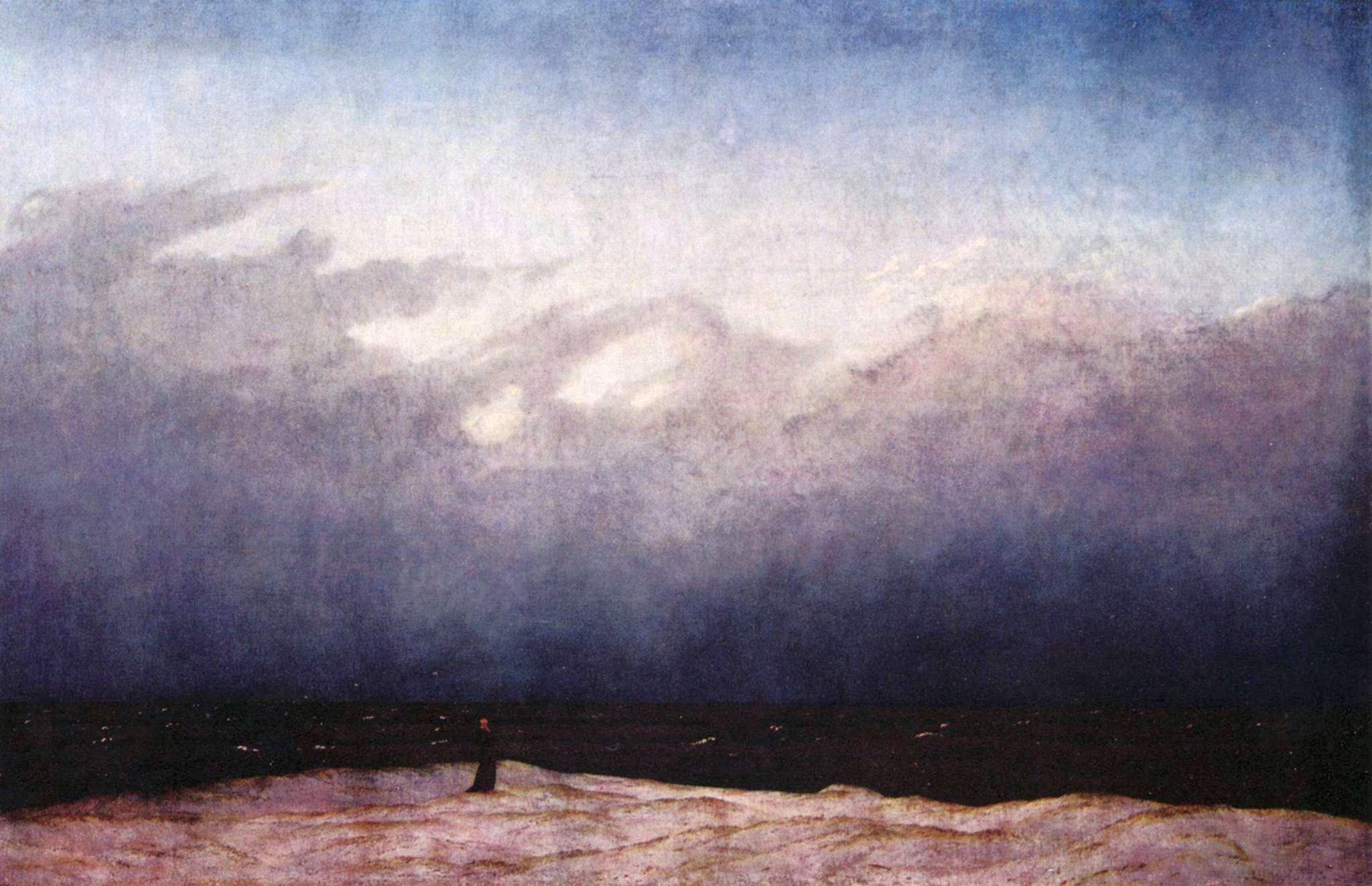
Take a look at Friedrich's painting Monk by the Sea. Most Art teachers will tell you it is the magnificence of Nature (and for Friedrich, that meant God) surrounding the insignificance of man. The dark colors and angry sky suggest power and sometimes indifference to the small soul on the beach. Much like Stephen Crane's "The Open Boat." But, if you look at it another way, isn't the magnificence of Nature including the man standing on the beach? We are included in that Greatness, that God created us as he created the sea, the sky, both dreadful and beautiful. As are we. Both dreadful and beautiful. Acts of both monsterous cruelty or benefinence.
***
Haven't you always wanted to rewrite movie scenes, ones where you just wonder what the character was thinking. Take My Girl for instance. Macauley Culkin's character was allergic to bees. If I remember correctly, he knew he was, had an epi-pen to undo allergic reactions. Yet there he was, away from home, walking through the forest, and he sees a hive-like object on the ground. So he kicks it..... and gets attacked. And now that scene lives on for eternity in movies. And some million years from now, citizens on Alpha Centauri will watch that scene and say, "What was he thinking!!!"
***
Quick Reviews: David Gray's Draw the Line. On the heal of Life in Slow Motion, it looks like David wanted to intigrate the Pro Tools synthesizers to live symphony recordings. And while I appreciated the albums by Matchbox Twenty that have been criticized for being overproduced. This album actually is badly overproduced. You can't hear the words all that well, although the lyrics are ingeniously done and very Dylanesque. He needs to take this album back to the simplicity ofWhite Ladder and New Day at Midnight. Or, better yet, there is a live album he cut in 2007, called Thousand Miles Behind which pays amage* to folk singers that came before him. He covers songs by Tim Buckley, Bob Dylan, and others that I haven't discovered yet, but will. Excellent singing, amazing lyrics, and the instrumentals are good too. So find that one somehow (it's not in the Borders database....maybe online), and listen to it, even if you're not a David Gray fan or know who he is. Although, if you do get the new album, get the deluxe edition, because the second CD has a mix of live tracks and B-sides which are really good, especially "Babylon," his most famous song.
***
Where the Wild Things Are Soundtrack: It is what it is. It is sung by Karen O and the Kids, along with what a reviewer called "primitive folk music." It reminds me a lot of Sufjan Stevens style of folk. Pan flutes, piano, guitar, some with a modal melody (meaning, in Tom Leher's dictionary, that they play a wrong note every now and then), and the laughter of kids. It is the raucous melody of children playing on the playground, the screams and shouts, first annoying, then infiltrating towards something nostalgic and wonderful, that sparks our imagination. In short, the Soundtrack puts into sound what the book puts into words. And hopefully, what the film will put into a colorful and meaningful piece of art. To me, the film should not be just a children's flick, but something that reaches into the hearts of adults and finds what remnant of childhood each of us still has left.
Someday, when you're feeling low (oops, James Dean song), go to the QT and fix this excellent perk up. Go to the fountain drinks, and mix together some of the Rooster Boost Energy Drink (just a little, on the bottom for Strawberry Flavoring), then Dr Pepper, then add the Vanilla flavoring. Mix, Pay, and slurp.... sooooo good (what it does to your blood sugar is another story.)
***
I just went to the Roly Poly restaurant by Kroger on Ga 138 in Conyers, and got a sandwich (while waiting for my car to start, which it didn't.) wrap (philly cheese) and some of their potato salad. As one of my friends would say, OMG, you have to get some tater salad!!! It's amazing!!! I'm gonna go get a big container of it for $4.99.
***
Take a look at Friedrich's painting Monk by the Sea. Most Art teachers will tell you it is the magnificence of Nature (and for Friedrich, that meant God) surrounding the insignificance of man. The dark colors and angry sky suggest power and sometimes indifference to the small soul on the beach. Much like Stephen Crane's "The Open Boat." But, if you look at it another way, isn't the magnificence of Nature including the man standing on the beach? We are included in that Greatness, that God created us as he created the sea, the sky, both dreadful and beautiful. As are we. Both dreadful and beautiful. Acts of both monsterous cruelty or benefinence.
***
Haven't you always wanted to rewrite movie scenes, ones where you just wonder what the character was thinking. Take My Girl for instance. Macauley Culkin's character was allergic to bees. If I remember correctly, he knew he was, had an epi-pen to undo allergic reactions. Yet there he was, away from home, walking through the forest, and he sees a hive-like object on the ground. So he kicks it..... and gets attacked. And now that scene lives on for eternity in movies. And some million years from now, citizens on Alpha Centauri will watch that scene and say, "What was he thinking!!!"
***
Quick Reviews: David Gray's Draw the Line. On the heal of Life in Slow Motion, it looks like David wanted to intigrate the Pro Tools synthesizers to live symphony recordings. And while I appreciated the albums by Matchbox Twenty that have been criticized for being overproduced. This album actually is badly overproduced. You can't hear the words all that well, although the lyrics are ingeniously done and very Dylanesque. He needs to take this album back to the simplicity of
***
Where the Wild Things Are Soundtrack: It is what it is. It is sung by Karen O and the Kids, along with what a reviewer called "primitive folk music." It reminds me a lot of Sufjan Stevens style of folk. Pan flutes, piano, guitar, some with a modal melody (meaning, in Tom Leher's dictionary, that they play a wrong note every now and then), and the laughter of kids. It is the raucous melody of children playing on the playground, the screams and shouts, first annoying, then infiltrating towards something nostalgic and wonderful, that sparks our imagination. In short, the Soundtrack puts into sound what the book puts into words. And hopefully, what the film will put into a colorful and meaningful piece of art. To me, the film should not be just a children's flick, but something that reaches into the hearts of adults and finds what remnant of childhood each of us still has left.
Friday, October 2, 2009
Kenny on the Mountaintop (last one)
I've always thought that everyone had the ability to stand on the mountaintop. If you look at Caspar David Freidrich's painting Traveler on a Sea of Fog, which is my favorite painting, you see a man calming looking out into the distance at far peaks, after having reached the cliff tops. It's an amazing work. The man himself, just like Howard Roarke standing atop of his masterpiece at the end of The Fountainhead, or Frankenstein at the top of the Alps, has a clear countenance. He has achieved the pinnacle of human thought, and it's this that I want to talk about, to end this series of individuality. Because, like I said, I always thought that anyone could reach this state of being. I have found out that not everyone can, and there are reasons why.
Maslow, a prominent sociological figure, made a pyramid called the Hierarchy of Needs. The premise is that people must fulfill basic needs before moving on to mental and spiritual needs. At the bottom, are food, water, shelter, etc..., Then social needs, happiness, a job, friendship, biological reproductive needs...etc..., and at the top, is total mental and spiritual awareness, something he called "Self-Actualization." And I've seen the people who are mentally aware of themselves. You can tell, it's like they have their eyes open. They are the people that have the ability to reach the mountaintop, the top of the pyramid. They are the individuals that I have talked about in past blogs.
When I ended the last blog, a friend of mine commented that the individuality that I was talking about was not always attainable by all people. The reason, she said, was that not everyone in the world has the same mental capacity and ability to reach the upper stages of Maslow's pyramid. Of course, there are numerous reasons for this, not all of them known to us now. But as the pyramid shows us, if people are not able to achieve basic physical needs - food, shelter, water - they cannot be expected to cogitate on the spiritual world, or deem any sort of meaning in exploring the innermost consciousness or in achieving individuality. In fact, they probably would shun away from such an idea. A person who has been without would not be independent, but dependent on whatever entity would come about to provide them with the basics. This entity could be something known, as a government or charity organization, or it could be supernatural, such as provision given by God.
Government as Entity
The Government has become an primary entity that provides people with the basic steps outlined in Maslow's pyramid. They provide protection (military), bread and food (Welfare and other subsidies), shelter (HUD, Fannie Mae, other Government programs for low-income housing), and other things as well. In some instances, I feel, the government has a right and an obligation to do these things. The government's main responsibility is to protect its citizens from outside threats, and we have the greatest military force ever assembled to help us do that. It also should provide certain basic services for those that absolutely could not afford or be able to live without them (SSI, for instance). This is what the life and liberty parts of the Preamble to the Constitution talked about. It's the Pursuit of Happiness that gets a little more difficult, and is what takes me into my argument.
To me, the "pursuit of happiness" is the liberty to pursue the path of independence. To achieve "The American Dream" as it were. Because it is precisely the American Dream that makes this country as amazing as it is. It is not to be rich, necessarily, or completely successful. Happiness, as I believe the writers of the Constitution saw it, was to have the independence to control one's own life, to live out that life at one's own choosing. In today's capitalist market, that does tend to equate with financial success and wealth, but it doesn't have to. The Constitution doesn't say that we are guaranteed this, because in order to climb up Maslow's pyramid, we have to do most of it on our own. The Constitution simply says that the government has an obligation to start us off. To provide the foundation for individuals who have no foundation to start with. But that is all it is supposed to do. To provide any more, or to expect recompense, is to exert itself onto the individual more than it should. When an individual climbs up to the pinnacle, and finds that an organization is there waiting for him to serve it, then we have eliminated self-actualization and replaced it with another entity. We have become enslaved to the people that are providing for us. Much as the Pharoah was God and ruler to the people of Egypt, so are the organizations and entities that sit atop Maslow's pyramid, waiting to be served and depended upon. It is we that give them the power over us, it is our sanction that allows other people to give us direction in life. And since I'm talking about the Government first, let's look at how the Government takes the pinnacle of "Self-Actualization" and makes it into its own Mount Olympus, for us to be dependent upon.
***
Looking down from the tower high above London (600 years A.F.), Mustapha Mond smiles in the knowing way that he would have, seeing the horizon of a city filled with happy people. The unhappy ones, like Bernard and Helmholtz Watson, he had banished to Iceland, where independent thinkers would not upstage the world government by challenging the collective laws. The city languishes in amusement centers, drug supplemental centers (places where they give people free drugs, called Soma), and churches (which are little but gatherings for orgies of habitual pleasure). All this, of course, takes place in Aldous Huxley's novel Brave New World, where Mustapha is the leader of the European area of the World. The government of this Dystopian world rules through providing its citizens with everything. From the basics to everything they would need to attain happiness, even to the genetically controlled DNA makeup in their bodies. The provide recreation, sex, drugs, anything except material that would cause those who could think the desire to do so. All education is done through osmosis and sleeping chambers, and during the day, the children are taught the skills necessary to be happy, from games to sexual discoveries. There is no poverty, no unhappiness in life, and death is simply done in chambers where the elderly are "soma'ed" until their bodies stop functioning.
Obviously, today's government doesn't rule our lives like this. But it makes sense. Why would a government rule by fear, such as in Orwell's 1984 or in places like the Romulan Empire (Star Trek) when they can rule by happiness. Give the people everything they want, and then eliminate the need for anything else. There would be no desire to think outside the box, because it would not occur to them that there was an "outside." A government that would do this has ultimate control over the people's lives, and there would be no one to question them. For those who control your life have power over it.
[ As a side note, there are many dystopian novels and programs that will further deal with this issue. Among them:
Andre Norton Outside
Movie: Logan's Run
Ray Bradbury: "The Pedestrian"
Frank Bonham The Forever Formula
D.J. MacHale Pendragon Book 7: The Quillan Games]
The government does provide recreation, happiness, and passivity to all it's citizens, if they choose it. Certainly there is no more addicting game than the lottery to blow your life savings on, trying to get an even bigger life savings. There have been proposals made to provide Underground Atlanta with Casino type machines that would support the economy there as well as provide funds for the Georgia Lottery. There are also instances of medications like Viagra being paid for through government health care programs. Now, with the proposal of health care reform under the current administration, it will be easy to get Prozac, Viagra, Zoloft....anything to make us a happier nation. And, I am sure, the government will have no problems giving those medications out, as it will neutralize the unsatisfied and quell the bitter. Soma, as Huxley called it, is not so far away.
A government that provides happiness does it at a price. The dependency on the government to make you happy takes away your independence, and keeps you from reaching that last level of self-actualization. If you have the American dream handed to you, you have achieved nothing, and so that is what it's worth. Working to achieve your dreams, even if it might be harder, is worth the sweat and toil, because the rewards will be yours. And of course the government will try to take that away from you, because it wasn't given to you by them, so you should give it to them instead. This line of thinking runs right into Ayn Rand's philosophies, so I'll let her finish where I was going.
The proper government is one that interferes as little as possible in the private lives of its citizens. The only thing the Constitution gives them the right to do is to allow citizens the "pursuit" of happiness. It cannot and should not give it to them. Let the people fail. Let the economy tank and see hard times come about. Apart from providing the basics of Maslow's pyramid (shelter, food, water), the Government should let the economic system fix itself. The lessons learned from failure can only make the human race stronger, more durable. Today, it is soft, weak, whining. I see too many stories where 911 was called because the people at McDonalds gave them the wrong burger. I have witnessed the depravity of the human condition on Judge Alex. Makes me wish for a second Noah flood, so sickening are the people that appear as specimens of our society. They are the ones that need hard times so that they can learn what their grandparents learned at the turn of the 20th century. And these are the people I thought could achieve individuality and self-actualization. I realize that this will never happen as long as the government continues to provide economic security and superficial happiness to its people.
Education as Tool
"Give a man a fish, and you've fed him for a day. Teach him how to fish, and you've fed him for a lifetime." A popular quote in education circles. Something that makes teachers all warm and fuzzy inside (in return for not being paid what their worth). I know I've looked at Education in the previous blog or two, but there's something I wanted to touch on in regard to the Government (or the Church, as private schools go) as Entities in place of Self-actualization. Public education here in America, while being some of the best "free" schooling in the world, has its drawbacks. I mentioned in the last blog the Biblical verse about "diligently seeking." I heartily approve of this for almost anything that one does. But I hardly call what public schools think is education "diligent." It is as if a giant spoon is coming to each child and force feeding them information, to simply be regurgitated onto some standardized test, before forgotten thereafter. And what is effective in Huxley's novel is clearly not effective here. We can't just download the information into children's heads and expect them to become productive, knowledgeable citizens. They have to want to learn it. They have to seek knowledge out and combine it with a priori knowledge. Else it becomes lost in the mess of consciousness and subconscious yearnings.
As a tool for the government, public education works only half the time. In general, the government sets the curriculum (both stated and unstated) and the teachers do their best to fulfill this. While I could go into a tirade of the political bias of teachers and the liberal leanings of teacher organizations, I won't, because there are too many blogs that deal specifically with this. But if children are taught that the government is here to provide us with everything we could ask for, as if citizens had a right for the luxuries that our anscestors worked so hard for, then children will learn that individuality, that hard work and diligently seeking anything, isn't worth it, because the government will provide everything that is needed. Therefore, self-actualization isn't necessary.
Where education fails in our system, is that it does not provide the students with the skills to do anything with their lives outside of school. True, there is some minimal vocational training going on in some of the schools (Rockdale Career Academy, for instance), but it is certainly looked down upon by those that matter. A vocational degree is often looked at as something that the delinquents get because they do not or could not go to "college." The true path is to graduate with a "college prep" diploma, and then go to college and get a "liberal arts" degree. This is the most highly looked upon path. Then a student can go to med school or law school or wherever. Being an auto mechanic, or a welder, or a plumber, or someone that works on Air Conditioning, that is not a job for a "civilized person." Our public school system treats those careers in this manner. Therefore, everyone that graduates from high school might know how to type, but nothing else useful. And then we spend hundreds of thousands of dollars to specialists that keep our machines running and our lives comfortable. We should be able to do it ourselves. But there is no way to learn these skills outside of our parents' teachings.
Therefore I propose that every student in public school take a "Life Skills" course, where private enterprise comes in, teaches everyone how to do basic maintenance and skills that are needed to become self-sufficient (unless a transmission blows). Changing oil, changing the wiring in an electrical socket, wiring a ceiling fan, the parts of a lawn mower, balancing a checkbook, etc... Do what Home Ec. is supposed to do. Sure, taking AP courses and Comparative Literature and Calculus is important, but living life is equally so. We must teach our students to seek diligently their goals and dreams, to improve their lives, to improve all of our lives.
Among the most important things that schools today must teach their students is information literacy. In today's world, reading is not enough. Technology has progressed us beyond simply a reading culture. Now, we use visual communication far more than mere words. Postman's ideas in Amusing Ourselves to Death, that the medium is the message, is as important as what is said. They must learn how to use the information gathered from the Internet, from TV, from the news, and apply it to what they already know. They must interpret the data being flooded in to their brains. This, and only this, will allow self-actualization to occur. I find it surprising, given the amount of revolutionary technology that has been developed since the 1990's, that school curricula have not included information literacy into their requirements. In fact, most schools are languishing behind with out of date technology and limited ability to use what they have. I had a teacher complaining to me about, while she was in a brand new school, made with the most up to date equipment they could get, had no computer in her room. She wondered where all the funding went. Controlling what children learn, and what they don't learn, is the critical tool that any Entity uses to keep themselves at the top of Maslow's pyramid. This includes any government (whether on purpose or subconsciously), or the Church, past, or present.
The Church as Entity
It's amazing how hard it is to write this section. All during my attempts to think this through, I've had to separate the "Church" entity from God as Entity. Because certainly God is one. And there certainly is a difference. In my beliefs, God is the only Entity which accepts mankind climbing as high as he can. Note that obviously God does not want man to climb to an equal footing as He, as the Tower of Babel episode doth explain. But climbing to as high a summit as man's mind will let him reach, this is perfectly acceptable, and even desirable. What would Man be, having been made in the image of God, if he could not reach his full potential? Why would God want to prevent His creation from becoming the most it can be? Therefore God as Entity is perfectly suitable to sit atop Maslow's pyramid of Needs, because God does not supplant Self-Actualization, He merely enables it.
The Church, on the other hand, has for centuries been a force that has kept mankind from reaching his full potential. Even in Biblical times, the Christian church was wrought with problems. Each letter that Paul wrote to the churches of Asia Minor contained issues that the Church faced at that time. The concept of a church, in the way that man has conceived of it, is simply another power heirarchy, where people congregate, and men in leadership roles have power over those below them. This is a perfectly acceptable idea, as William Golding demonstrated in Lord of the Flies. Some sort of leadership structure must be maintained, for those who have not yet reached Self-Regulation (which also cannon happen without self-actualization), need the guidance of those wiser than they. Plato saw it, in The Republic, and America's founders realized this as well, else they would not have made a Federal government at all.
The problem arises when the people in power try to keep mankind from reaching his full potential by withholding necessary steps in Maslow's pyramid. The Church has, for centuries, done just that. It is ironic that, in the Middle Ages, it was the Catholic Church that preserved the knowledge of the Roman Empire while keeping it from the general population. This is done most effectively by not teaching everyone to read. In the Middle ages, with books not readily available, and education handled by the richest private schools, or the clergy, a very small percentage could actually attain the knowledge passed down by their ancestors. Most of those people were either in the clergy or in places of power. Therefore keeping the general population illiterate was most advantageous. This method of control is similar to not wanting slaves to read in America during the 1800's. In this most direct example, the Church of the Middle Ages kept mankind from climbing to the apex of his abilities.
But what about the Church today? Certainly, thanks to Gutenburg, books and other media are quite common. And Martin Luther founded the Protestant movement, where every individual being has direct communication and a relationship with God. In a sense, Christianity should be a Libertarian religion, with each individual having a relationship with God, and seeking to know him better through the scriptures, through other people (church), and through the miracles and wonders of daily life. But more often, I see the power structure of a denomination or an independent church rising up to take the place of individual thinking. In the Baptist denomination, people have long been forbade to dance. In my own family, my grandfather found card playing sinful, but had no problem dating after he was married. Recently, church groups have formed political parties (such as the moral majority) to actively back candidates. It seems to me that churches need to spend less time on telling people what to think, and more time instructing people on how to pursue a relationship with God based on the Bible. Yet we have pastors such as the Rev. Jeremiah Wright preaching from the pulpit that 9/11 was revenge on white people, and such theories. We have pastors telling their congregations who to vote for, and how to decide on amendments and laws and such. Show us the Bible passages, and let us make up our own minds. If we are wrong, then let that be between God and us.
And it goes beyond that. As I have said in a past blog (Adding Points to the Compass), I found "collectible bookmarks" in all of Borders' copies of The Golden Compass basically saying how Pullman's works were sinful and Athiest (true, Pullman is an atheist), and then gave a web site that continues with this line of thinking, linked to a church that passed out the bookmarks to people who requested them. It was an underhanded ploy not meant to be in a bookstore. If the church in question wanted to have people outside our bookstore handing them out, let them go ahead. Or publish a book decrying the philosophies of Philip Pullman, and I'll be glad to put it right next to it. But placing unauthorized material inside the books without our knowledge.... that is beyond the pale. Why not put pro-Jewish bookmarks inside of Mein Kampf, or anti-pedophilia pamplets inside of Lolita? Let the people read as they choose, and decide for themselves what to believe, and let the final judgement be for God.
In the end, it is always up to the individual to decide. I have this theory, and Galileo would agree with me, that if churches let people decide what they want to believe for themselves, that religion would slowly fade away. They are scared that self-actualization would bring about groups of people who don't see the empirical evidence of God, and therefore believe that he doesn't exist. They are afraid of losing their power and influence over all those people who don't have the ability to self-actualize. The church would stand, as Mustapha Mond did, atop the tower in London, and fear for the people below actually being able to think for themselves. And the less people that actually could do that, the better off the Church would be. I am not saying that those Sunday School teachers that I have mentioned in the past were deliberately trying to brainwash us, keep us from questioning the tennants of Christianity, in the fear that we might not find them to be true. But I am sure that somewhere, Church officials would rather us not question the prinicples of their denominations, for fear that we might find that we can believe and worship God on our own.
I wonder though, what God would feel like, if He looked down upon the world and find that Mankind had truly advanced to the point where they were all self-aware. What if God didn't need to do anything, as we had achieved all that he had wanted. (Of course, this isn't going to happen.... however....) I remember, in my youth, playing a game on the Super Nintendo called Actraiser, and, coming to the end of the game, the Angel tells us (the player actually being "God,") that isn't it every Diety's wish for the people that live under them to not need them anymore? For God to be proud of us for reaching the pinnacle of our abilities, to all reach the top of the mountains, and look out unto Paradise. Yes, I think God would be very proud indeed.
***
I'm gonna move on to other topics, silly and profound, and say good bye to Kenny and Butters and the rest. Honestly, I'm not really a big fan of South Park, but I appreciate the legitimate questions they raise. A note about these last few blogs. There will come a time, undoubtedly, when my opinions change, and I will believe differently than this. If you ask me now, do I believe all that I have written, I will answer, "Probably." But as Emerson said, minds can be changed. If I contradict myself...then fine, I will contradict myself. But for now, this will do.
Maslow, a prominent sociological figure, made a pyramid called the Hierarchy of Needs. The premise is that people must fulfill basic needs before moving on to mental and spiritual needs. At the bottom, are food, water, shelter, etc..., Then social needs, happiness, a job, friendship, biological reproductive needs...etc..., and at the top, is total mental and spiritual awareness, something he called "Self-Actualization." And I've seen the people who are mentally aware of themselves. You can tell, it's like they have their eyes open. They are the people that have the ability to reach the mountaintop, the top of the pyramid. They are the individuals that I have talked about in past blogs.
When I ended the last blog, a friend of mine commented that the individuality that I was talking about was not always attainable by all people. The reason, she said, was that not everyone in the world has the same mental capacity and ability to reach the upper stages of Maslow's pyramid. Of course, there are numerous reasons for this, not all of them known to us now. But as the pyramid shows us, if people are not able to achieve basic physical needs - food, shelter, water - they cannot be expected to cogitate on the spiritual world, or deem any sort of meaning in exploring the innermost consciousness or in achieving individuality. In fact, they probably would shun away from such an idea. A person who has been without would not be independent, but dependent on whatever entity would come about to provide them with the basics. This entity could be something known, as a government or charity organization, or it could be supernatural, such as provision given by God.
Government as Entity
The Government has become an primary entity that provides people with the basic steps outlined in Maslow's pyramid. They provide protection (military), bread and food (Welfare and other subsidies), shelter (HUD, Fannie Mae, other Government programs for low-income housing), and other things as well. In some instances, I feel, the government has a right and an obligation to do these things. The government's main responsibility is to protect its citizens from outside threats, and we have the greatest military force ever assembled to help us do that. It also should provide certain basic services for those that absolutely could not afford or be able to live without them (SSI, for instance). This is what the life and liberty parts of the Preamble to the Constitution talked about. It's the Pursuit of Happiness that gets a little more difficult, and is what takes me into my argument.
To me, the "pursuit of happiness" is the liberty to pursue the path of independence. To achieve "The American Dream" as it were. Because it is precisely the American Dream that makes this country as amazing as it is. It is not to be rich, necessarily, or completely successful. Happiness, as I believe the writers of the Constitution saw it, was to have the independence to control one's own life, to live out that life at one's own choosing. In today's capitalist market, that does tend to equate with financial success and wealth, but it doesn't have to. The Constitution doesn't say that we are guaranteed this, because in order to climb up Maslow's pyramid, we have to do most of it on our own. The Constitution simply says that the government has an obligation to start us off. To provide the foundation for individuals who have no foundation to start with. But that is all it is supposed to do. To provide any more, or to expect recompense, is to exert itself onto the individual more than it should. When an individual climbs up to the pinnacle, and finds that an organization is there waiting for him to serve it, then we have eliminated self-actualization and replaced it with another entity. We have become enslaved to the people that are providing for us. Much as the Pharoah was God and ruler to the people of Egypt, so are the organizations and entities that sit atop Maslow's pyramid, waiting to be served and depended upon. It is we that give them the power over us, it is our sanction that allows other people to give us direction in life. And since I'm talking about the Government first, let's look at how the Government takes the pinnacle of "Self-Actualization" and makes it into its own Mount Olympus, for us to be dependent upon.
***
Looking down from the tower high above London (600 years A.F.), Mustapha Mond smiles in the knowing way that he would have, seeing the horizon of a city filled with happy people. The unhappy ones, like Bernard and Helmholtz Watson, he had banished to Iceland, where independent thinkers would not upstage the world government by challenging the collective laws. The city languishes in amusement centers, drug supplemental centers (places where they give people free drugs, called Soma), and churches (which are little but gatherings for orgies of habitual pleasure). All this, of course, takes place in Aldous Huxley's novel Brave New World, where Mustapha is the leader of the European area of the World. The government of this Dystopian world rules through providing its citizens with everything. From the basics to everything they would need to attain happiness, even to the genetically controlled DNA makeup in their bodies. The provide recreation, sex, drugs, anything except material that would cause those who could think the desire to do so. All education is done through osmosis and sleeping chambers, and during the day, the children are taught the skills necessary to be happy, from games to sexual discoveries. There is no poverty, no unhappiness in life, and death is simply done in chambers where the elderly are "soma'ed" until their bodies stop functioning.
Obviously, today's government doesn't rule our lives like this. But it makes sense. Why would a government rule by fear, such as in Orwell's 1984 or in places like the Romulan Empire (Star Trek) when they can rule by happiness. Give the people everything they want, and then eliminate the need for anything else. There would be no desire to think outside the box, because it would not occur to them that there was an "outside." A government that would do this has ultimate control over the people's lives, and there would be no one to question them. For those who control your life have power over it.
[ As a side note, there are many dystopian novels and programs that will further deal with this issue. Among them:
Andre Norton Outside
Movie: Logan's Run
Ray Bradbury: "The Pedestrian"
Frank Bonham The Forever Formula
D.J. MacHale Pendragon Book 7: The Quillan Games]
The government does provide recreation, happiness, and passivity to all it's citizens, if they choose it. Certainly there is no more addicting game than the lottery to blow your life savings on, trying to get an even bigger life savings. There have been proposals made to provide Underground Atlanta with Casino type machines that would support the economy there as well as provide funds for the Georgia Lottery. There are also instances of medications like Viagra being paid for through government health care programs. Now, with the proposal of health care reform under the current administration, it will be easy to get Prozac, Viagra, Zoloft....anything to make us a happier nation. And, I am sure, the government will have no problems giving those medications out, as it will neutralize the unsatisfied and quell the bitter. Soma, as Huxley called it, is not so far away.
A government that provides happiness does it at a price. The dependency on the government to make you happy takes away your independence, and keeps you from reaching that last level of self-actualization. If you have the American dream handed to you, you have achieved nothing, and so that is what it's worth. Working to achieve your dreams, even if it might be harder, is worth the sweat and toil, because the rewards will be yours. And of course the government will try to take that away from you, because it wasn't given to you by them, so you should give it to them instead. This line of thinking runs right into Ayn Rand's philosophies, so I'll let her finish where I was going.
The proper government is one that interferes as little as possible in the private lives of its citizens. The only thing the Constitution gives them the right to do is to allow citizens the "pursuit" of happiness. It cannot and should not give it to them. Let the people fail. Let the economy tank and see hard times come about. Apart from providing the basics of Maslow's pyramid (shelter, food, water), the Government should let the economic system fix itself. The lessons learned from failure can only make the human race stronger, more durable. Today, it is soft, weak, whining. I see too many stories where 911 was called because the people at McDonalds gave them the wrong burger. I have witnessed the depravity of the human condition on Judge Alex. Makes me wish for a second Noah flood, so sickening are the people that appear as specimens of our society. They are the ones that need hard times so that they can learn what their grandparents learned at the turn of the 20th century. And these are the people I thought could achieve individuality and self-actualization. I realize that this will never happen as long as the government continues to provide economic security and superficial happiness to its people.
Education as Tool
"Give a man a fish, and you've fed him for a day. Teach him how to fish, and you've fed him for a lifetime." A popular quote in education circles. Something that makes teachers all warm and fuzzy inside (in return for not being paid what their worth). I know I've looked at Education in the previous blog or two, but there's something I wanted to touch on in regard to the Government (or the Church, as private schools go) as Entities in place of Self-actualization. Public education here in America, while being some of the best "free" schooling in the world, has its drawbacks. I mentioned in the last blog the Biblical verse about "diligently seeking." I heartily approve of this for almost anything that one does. But I hardly call what public schools think is education "diligent." It is as if a giant spoon is coming to each child and force feeding them information, to simply be regurgitated onto some standardized test, before forgotten thereafter. And what is effective in Huxley's novel is clearly not effective here. We can't just download the information into children's heads and expect them to become productive, knowledgeable citizens. They have to want to learn it. They have to seek knowledge out and combine it with a priori knowledge. Else it becomes lost in the mess of consciousness and subconscious yearnings.
As a tool for the government, public education works only half the time. In general, the government sets the curriculum (both stated and unstated) and the teachers do their best to fulfill this. While I could go into a tirade of the political bias of teachers and the liberal leanings of teacher organizations, I won't, because there are too many blogs that deal specifically with this. But if children are taught that the government is here to provide us with everything we could ask for, as if citizens had a right for the luxuries that our anscestors worked so hard for, then children will learn that individuality, that hard work and diligently seeking anything, isn't worth it, because the government will provide everything that is needed. Therefore, self-actualization isn't necessary.
Where education fails in our system, is that it does not provide the students with the skills to do anything with their lives outside of school. True, there is some minimal vocational training going on in some of the schools (Rockdale Career Academy, for instance), but it is certainly looked down upon by those that matter. A vocational degree is often looked at as something that the delinquents get because they do not or could not go to "college." The true path is to graduate with a "college prep" diploma, and then go to college and get a "liberal arts" degree. This is the most highly looked upon path. Then a student can go to med school or law school or wherever. Being an auto mechanic, or a welder, or a plumber, or someone that works on Air Conditioning, that is not a job for a "civilized person." Our public school system treats those careers in this manner. Therefore, everyone that graduates from high school might know how to type, but nothing else useful. And then we spend hundreds of thousands of dollars to specialists that keep our machines running and our lives comfortable. We should be able to do it ourselves. But there is no way to learn these skills outside of our parents' teachings.
Therefore I propose that every student in public school take a "Life Skills" course, where private enterprise comes in, teaches everyone how to do basic maintenance and skills that are needed to become self-sufficient (unless a transmission blows). Changing oil, changing the wiring in an electrical socket, wiring a ceiling fan, the parts of a lawn mower, balancing a checkbook, etc... Do what Home Ec. is supposed to do. Sure, taking AP courses and Comparative Literature and Calculus is important, but living life is equally so. We must teach our students to seek diligently their goals and dreams, to improve their lives, to improve all of our lives.
Among the most important things that schools today must teach their students is information literacy. In today's world, reading is not enough. Technology has progressed us beyond simply a reading culture. Now, we use visual communication far more than mere words. Postman's ideas in Amusing Ourselves to Death, that the medium is the message, is as important as what is said. They must learn how to use the information gathered from the Internet, from TV, from the news, and apply it to what they already know. They must interpret the data being flooded in to their brains. This, and only this, will allow self-actualization to occur. I find it surprising, given the amount of revolutionary technology that has been developed since the 1990's, that school curricula have not included information literacy into their requirements. In fact, most schools are languishing behind with out of date technology and limited ability to use what they have. I had a teacher complaining to me about, while she was in a brand new school, made with the most up to date equipment they could get, had no computer in her room. She wondered where all the funding went. Controlling what children learn, and what they don't learn, is the critical tool that any Entity uses to keep themselves at the top of Maslow's pyramid. This includes any government (whether on purpose or subconsciously), or the Church, past, or present.
The Church as Entity
It's amazing how hard it is to write this section. All during my attempts to think this through, I've had to separate the "Church" entity from God as Entity. Because certainly God is one. And there certainly is a difference. In my beliefs, God is the only Entity which accepts mankind climbing as high as he can. Note that obviously God does not want man to climb to an equal footing as He, as the Tower of Babel episode doth explain. But climbing to as high a summit as man's mind will let him reach, this is perfectly acceptable, and even desirable. What would Man be, having been made in the image of God, if he could not reach his full potential? Why would God want to prevent His creation from becoming the most it can be? Therefore God as Entity is perfectly suitable to sit atop Maslow's pyramid of Needs, because God does not supplant Self-Actualization, He merely enables it.
The Church, on the other hand, has for centuries been a force that has kept mankind from reaching his full potential. Even in Biblical times, the Christian church was wrought with problems. Each letter that Paul wrote to the churches of Asia Minor contained issues that the Church faced at that time. The concept of a church, in the way that man has conceived of it, is simply another power heirarchy, where people congregate, and men in leadership roles have power over those below them. This is a perfectly acceptable idea, as William Golding demonstrated in Lord of the Flies. Some sort of leadership structure must be maintained, for those who have not yet reached Self-Regulation (which also cannon happen without self-actualization), need the guidance of those wiser than they. Plato saw it, in The Republic, and America's founders realized this as well, else they would not have made a Federal government at all.
The problem arises when the people in power try to keep mankind from reaching his full potential by withholding necessary steps in Maslow's pyramid. The Church has, for centuries, done just that. It is ironic that, in the Middle Ages, it was the Catholic Church that preserved the knowledge of the Roman Empire while keeping it from the general population. This is done most effectively by not teaching everyone to read. In the Middle ages, with books not readily available, and education handled by the richest private schools, or the clergy, a very small percentage could actually attain the knowledge passed down by their ancestors. Most of those people were either in the clergy or in places of power. Therefore keeping the general population illiterate was most advantageous. This method of control is similar to not wanting slaves to read in America during the 1800's. In this most direct example, the Church of the Middle Ages kept mankind from climbing to the apex of his abilities.
But what about the Church today? Certainly, thanks to Gutenburg, books and other media are quite common. And Martin Luther founded the Protestant movement, where every individual being has direct communication and a relationship with God. In a sense, Christianity should be a Libertarian religion, with each individual having a relationship with God, and seeking to know him better through the scriptures, through other people (church), and through the miracles and wonders of daily life. But more often, I see the power structure of a denomination or an independent church rising up to take the place of individual thinking. In the Baptist denomination, people have long been forbade to dance. In my own family, my grandfather found card playing sinful, but had no problem dating after he was married. Recently, church groups have formed political parties (such as the moral majority) to actively back candidates. It seems to me that churches need to spend less time on telling people what to think, and more time instructing people on how to pursue a relationship with God based on the Bible. Yet we have pastors such as the Rev. Jeremiah Wright preaching from the pulpit that 9/11 was revenge on white people, and such theories. We have pastors telling their congregations who to vote for, and how to decide on amendments and laws and such. Show us the Bible passages, and let us make up our own minds. If we are wrong, then let that be between God and us.
And it goes beyond that. As I have said in a past blog (Adding Points to the Compass), I found "collectible bookmarks" in all of Borders' copies of The Golden Compass basically saying how Pullman's works were sinful and Athiest (true, Pullman is an atheist), and then gave a web site that continues with this line of thinking, linked to a church that passed out the bookmarks to people who requested them. It was an underhanded ploy not meant to be in a bookstore. If the church in question wanted to have people outside our bookstore handing them out, let them go ahead. Or publish a book decrying the philosophies of Philip Pullman, and I'll be glad to put it right next to it. But placing unauthorized material inside the books without our knowledge.... that is beyond the pale. Why not put pro-Jewish bookmarks inside of Mein Kampf, or anti-pedophilia pamplets inside of Lolita? Let the people read as they choose, and decide for themselves what to believe, and let the final judgement be for God.
In the end, it is always up to the individual to decide. I have this theory, and Galileo would agree with me, that if churches let people decide what they want to believe for themselves, that religion would slowly fade away. They are scared that self-actualization would bring about groups of people who don't see the empirical evidence of God, and therefore believe that he doesn't exist. They are afraid of losing their power and influence over all those people who don't have the ability to self-actualize. The church would stand, as Mustapha Mond did, atop the tower in London, and fear for the people below actually being able to think for themselves. And the less people that actually could do that, the better off the Church would be. I am not saying that those Sunday School teachers that I have mentioned in the past were deliberately trying to brainwash us, keep us from questioning the tennants of Christianity, in the fear that we might not find them to be true. But I am sure that somewhere, Church officials would rather us not question the prinicples of their denominations, for fear that we might find that we can believe and worship God on our own.
I wonder though, what God would feel like, if He looked down upon the world and find that Mankind had truly advanced to the point where they were all self-aware. What if God didn't need to do anything, as we had achieved all that he had wanted. (Of course, this isn't going to happen.... however....) I remember, in my youth, playing a game on the Super Nintendo called Actraiser, and, coming to the end of the game, the Angel tells us (the player actually being "God,") that isn't it every Diety's wish for the people that live under them to not need them anymore? For God to be proud of us for reaching the pinnacle of our abilities, to all reach the top of the mountains, and look out unto Paradise. Yes, I think God would be very proud indeed.
***
I'm gonna move on to other topics, silly and profound, and say good bye to Kenny and Butters and the rest. Honestly, I'm not really a big fan of South Park, but I appreciate the legitimate questions they raise. A note about these last few blogs. There will come a time, undoubtedly, when my opinions change, and I will believe differently than this. If you ask me now, do I believe all that I have written, I will answer, "Probably." But as Emerson said, minds can be changed. If I contradict myself...then fine, I will contradict myself. But for now, this will do.
Subscribe to:
Posts (Atom)