Tuesday, December 25, 2012

Insular Worlds and School Shootings


A Facebook post, in which A. got annoyed with the amount of posts that seemed to show that people really just didn't care about the recent school shooting in Newtown, CT.  The postings I have seen have been basically pictures of angels, and of the children themselves, or posts supporting or being against (mostly against) gun control as a method of curbing future shooters from getting guns in the first place.  The feeling is more that if the rest of us have guns, those that want to use them for violence won't get very far.  Sort of a cold war Nuclear race type idea.  But most posts after this have been about life as it has gone for years, past and future, and A. is annoyed because it seems like no one cares.  My thoughts were to figure out if there was any support to this.  A.'s post in italics.

A: Y'know, MOST of my FB friends are thoughtful and considering in posting their comments during a time of seemingly unremitting bad news. And I'm hesitant to even post this, since the majority of those people are, allegedly, adults. There are a few, though, who seem to be living in their own little worlds, oblivious to anything and everything that falls outside of their self-contained insular nests. To those of you who fall into that latter category, here's a word of advice: when there is a mass murder, involving mostly innocent children, a crime so heinous that it throws the entire civilized world into shock and mourning, then no one gives a damn about the movie you just saw, your love of computers, the new color scheme of your bathroom, cutsie cards/posters, or your gaming passion. Not to be too preachy about it, but save that crap for another time. The rest of us will be OK without it.
 
I agree with you, to some extent. That's a complicated matter, as escapism is a tool people use to deal with circumstances such as this. And has the media made it so where, after the time they deemed necessary to talk about the CT shooting, it goes on to the next item, having trained us, on the evening news, to hear about the everyday shootings and fires and accidents and then move on, unmoved about the loss of human life. Is it that, the news that is reporting how monstrous mankind can be, is also training us to view it as normal, or overlook it as fringe happenings that deserve a ninety second story, and then on to the Weather, sports, and what happened on American Idol? Humans live in their compartmentalized, "insular" worlds and deal with issues even as they watch their football games and download apps. onto their Android phones. 

My mom retold the days following the Kennedy Assassination, where between news reports, the three channels played classical music for the entire weekend. She was shocked when, after the funeral and procession, when an advertisement actually came on. How far have we moved past those days, when commercials will be done no matter what is happening? Where there is always cable channels filled with escapist, entertaining, crap so that we would never have to face reality at all. And I do it too, as the Disney Channel stays on my TV most of the day. I play my Bejeweled Blitz and my Hidden Chronicles, and the world outside goes on unnoticed. It's unfortunate, but I don't believe that the majority of people who are on Facebook could *not* participate in mass escapism to deal with the Sandy Hook massacre, as the addiction of constant information gorging is far too powerful for them to watch one Television station, with no commercials, and classical music in between news of something that should bring us all together. Human beings are too busy being walled in by big screen TVs and tiny cell phones to deal with actual live human beings. We can reach out, and participate in world events just as instantly as they happen, yet that same ability keeps us even more distant from each other. It's the tragic irony of our times. As the politician on the Monkees movie "Head" said, "The tragedy of your times, my friends, is that you may get exactly what you want." How true that is.

It's also the fact that most people have a very limited attention span. No one, it seems, can focus on anything for more than a few moments. Thus the constant demand for digression: to the extent that television "news" rarely runs a story lasting more than thirty seconds. Absurd shows like "Good Morning America" intersperses tragedy with music, celebrity "news", weather, and so-called human interest stories. It's no wonder that the average American is misinformed about, well, everything. 

Yep.  How we communicate is as important as what we communicate (Postman), so we've been trained to communicate in 30 second sound bytes, 140 characters, get it out, make it known, no thinking, just instant response.  Move back and forth, from one subject to another. It's necessary, to some extent, in this world we live in. Compartmentalization allows us to sort out the vast amount of data that gets thrown at us every minute. Now, that doesn't mean that we're able to reflect, absorb, and learn from that information.  It also protects us from that raw data, as, for the longest time, we weren't able to instantly be aware of all the wrongs in this world.  Now, with the 24 hour news, the Internet, the cell phones, we can know everything going on.  And that's not good.  Robert Goolrick, author of The Reliable Wife, documented the many tragedies that happened in the northern states back prior to cars, electricity, medicine, where people went crazy and slaughtered their families, killed themselves...etc..., but no one knew about all of that, as CNN wasn't there to report on it.  Now, we didn't know, so we couldn't solve the problem.  We couldn't throw our money, our technology, our scientific knowledge at it.  But there was also no instant emotional response in rash legislation passed, no blame turned political, and no moving on as the next tragedy hit, and the next, and the next.  And the idea wasn't put into other, maybe mentally unstable, people's heads, so they could carry out the same thing the next time they forgot to take medication.  Copycat acts are the direct result of the communication of unsorted images and acts and emotions, all thrown out of televisions and computers.  We have to learn to think about the consequences of our actions, and in this society, that's not happening.  It all boils down to right and wrong, and in today's world of victims, moral relativity, and shades of gray, it's hard for a normal person to decide right from wrong, much less someone who might have a neurological problem.  Thus the results are ambushed firefighters, slain school children, and all the myriads of violent acts that happen every single day. 

Thursday, December 13, 2012

Book Review: The Isle of Shapeshifters by Otto Coontz

A daunting task lies ahead of me, one comparable to climbing Mount Everest or cleaning my basement... reading the books I have on my bookcases.  It's even more daunting because I'm adding more and more books every week.  Favorite authors, intriguing book covers, sizes and shapes, all of them crying out "Read Me!" like a piece of candy to Alice, before she inevitably shrinks or grows, or a cat meowing at an animal shelter.  So when I finish the last page of one book, I venture toward those bookcases and see which one meows at me the most.  Now, most of my books are stacked horizontally, so top ones get preference (cause I'm usually on the way to wait in a line or go to work.), and they're double stacked, so front also gets first shot.  So I pulled one off my shelves and took it to work.  It's a book called Isle of the Shapeshifters by Otto Coontz.

You certainly can't have a last name like "Coontz" and not be expected to write something akin to Horror.  Turns out, this particular book reminds me of Dean Koontz' writing, especially like his book The Taking.  It also is very typical of  the B-list horror movies that came out in the 70's and 80's.  The setting often becomes as much a character as any of the people.  It rains when bad things happen, wind, fog, earthquakes... a pathetic fallacy where nature becomes sentient, (although, in this book, it's actually controlled by the people living on the island.)  Mix that in with very well created characters, and description of the island that was amazing, and you have a great book.

After I finished the novel, I went to Google Maps and took at satellite tour of Nantucket Island, and it's exactly as Coontz described it in the novel.  Even today, so far removed from 1983, when the book was written, Nantucket is a desolate area with tourists and the local people living on certain parts of the island, but with an astonishing lack of resorts, casinos, and nature-wrecking buildings.  You could easily step back in time (as the book did) and see how the original natives of the island lived, as well as the fisherman that have made the place their home for years.


I certainly understood the ending, I just didn't have to like it. The main character, Theo, is on vacation on the island, as an invitation from the "fan club" of her vein soap opera star stepmother (typical stereotype, but it works). On the island, she meets Kip, who takes care of his elderly grandmother and whose dad works at the Oceanography center on the island. Together Kip and Theo explore the island, becoming interested in the Native American markings found on the rocks in the Moors and also on the strange pendent given to Theo by "the fan club." Little does she know it's an amulet that will draw the power she has inherited from her ancestors. Kip discovers the link, but can he save her before those that wish to use that power carry out their plans? The end doesn't tie all the ends together, as Theo leaves without even telling Kip good-bye. It feels like one of those Law & Order episodes where it ends without a satisfactory last note, like a song ending on something other than DO. It's why, when I put the star rating on this book, it only gets four out of five. Nothing I just said will spoil anything in the book, but you end up thinking, "A great book, if only...." This book is more than likely out of print, but it should be easy to find online or at used bookstores. I do recommend it for young adults, especially those that like things a little scary.

Sunday, December 2, 2012

Movie Review: Life of Pi

It is quite impossible, when reviewing this film (and the book), to discuss it without delving into the meat of the story.  Therefore spoilers will be abundant below the asterisks.  Please don't read below there if you plan on seeing the movie or reading the book (both of which are highly recommended.)

The Life of Pi is based on an incredible novel by Yann Martel.  I say this because you probably won't find any other work of his aside it at a bookstore, as they were not commercial successes.  It's like every author has a finite supply of "muse juice," the amount of works that, given a lifetime of creating and writing, that any one book will reach the point where, a century from now, it will still be read.  Harper Lee knew when not to write anymore, she had used up her muse juice, and To Kill a Mockingbird has probably been read (or at least seen) by millions of high school kids all across the world.  And I bring up Lee's novel because the film is highly faithful to the book, making it very possible to watch the film and understand almost everything that Lee intended.

Thus the same goes with the movie Life of Pi, directed by Ang Lee.  The story of how this novel became a movie is worth a book in itself, having gone from director to director, from screenwriter to screenwriter, with each succession of groups failing, with each director choosing another project to work on.  M. Night Shyamalan was slated to produce the movie first, but chose instead to film The Lady in the Water.  (I, for one, am SO glad M. Night did not direct this movie.) The current screenplay, written by David MaGee, compresses the emotion, the framework, the illusory ease by which you conclude the 2nd part, the shock of the 3rd part, and boils it all down into a movie which might be better than the book.  And let's face it, while reading the book will always be preferred, if you only have 3 hours to complete the story, it's very okay to watch this movie.  There will be no Indian attacks in The Scarlett Letter movie which was botched from the beginning.  There is no better way to experience this story than to watch the film.

One other note before I talk about the movie itself.  Watching it in 3D is essential to the story, as the visual effects of the ocean, of the animals and their movements, turns it from a critical success film-wise, to an artwork of motion, colors, and sound.   Much like Hugo a year ago, the 3D imagery does so much to accentuate the film, rather than be just a gimmick to draw you into the theatre.  I expect that if Titanic had first been released in 3D, it would still be the #1 movie at the box office.

The story behind the movie (book) is framed into three parts. Pi's life in India, which introduces us to the zoo that his father has created in the park within the French-Indian coastal town of Pondicherry during the 1970's, is written in lyric prose, Thoreauian, philosophical in nature, with words and scenes as lush as the Romance of exotic India which drew so many colonists there throughout the years.  The second part finds Pi stranded on a lifeboat in the middle of the Pacific Ocean, and the prose turns Hemingway-esque, parse, more concerned with survival and the realism of doing so (suffice it to say that it is best, while reading this part, not to be eating your lunch). And then the end, which I will speak of later.

I see I have talked about everything except the plot. A look at the book or movie cover will tell you as much, so it's not necessary.

I will warn, I guess, that those who are avid animal lovers will not like the movie, although I expect that no real animals were harmed during the filming.  For those of you like this, I recommend reading the book instead.

Go see the movie, and do it in the theatres before it goes away, in 3D, because seeing it on a normal TV won't have nearly the effect. 

**************************

What made the movie amazing, aside from the 3D imagery, the sheer strength of the characters, the soundtrack which added to the imagery as it swirled around Pi and his surroundings, was the ending.  To me, a movie reaches "great" status when it affects me in some way.  The ending, specifically, the alternate story that Pi gave the Japanese insurance agents who interviewed him in the hospital, was so troublesome, as it was exactly opposite of the story about faith, strength, compassion, that Pi had shown the whole movie.  But given the circumstances, man will do anything to survive.  It provided evidence that man is inherently evil.  In the alternate story, the animals that survived the crash were substituted for people, including Pi's mother.  The problem is, after everything we've experienced with Pi, with the Tiger, with all that was real or illusory, we can't tell, there's no way to know which story was true.

After I got home, I looked on IMDB to see other people's reaction to the film.  Most people loved the movie, but hated the ending.  Its unique, a movie in which the intent was to make you hate the ending.  But I think Ang Lee intended that all along.  And the surprise is that Yann Martel included the same scene in the third part of the novel.  Yet I didn't remember it.  I read the book, and loved it.  I would have remembered a plot twist such as this, but I didn't.  The only conclusion I can make is that my brain rejected the alternate version of the story that it completely blocked it, regarding it as a useless part of the book, something to be totally forgotten, to preserve the Romantic (capital R) version with the Tiger (who in the end could be considered the "Noble Savage.") I was amazed. I had to go back and reread the ending to make sure that it wasn't something Ang Lee just put on there as an addition.  We only remember what we want to.  History is only written, leaving out the things that mankind must do, or does, in the dark recesses of his heart, his mind.  It was a stark addition to the end, to say that not only is Nature indifferent to mankind's sentience, but man is indifferent to each other.  And I couldn't accept it.  To the point where I forgot the scene even happened.

*****************************

As additional reading, I recommend the following books as ancillary material to understanding the themes that come from Life of Pi.

Heart of Darkness by Joseph Conrad.  The framework is similar, as is the path of the hero, and the lie at the end of both stories that flaw the "hero" as complete.  Both stories also show the beauty and unrelenting evil of man and the world he lives in.

"The Open Boat" by Stephen Crane.  A short story about men stranded in a lifeboat just off shore.  Shows the indifference of nature, and our need to make heroes out of those on the boat.

Dove by Robin Lee Graham.  A teenager who saled on a ship around the world. From his total loneliness to finding his wife and finding faith, the book is very similar to Life of Pi, and is well worth reading. They made a movie of it as well, although I've never seen it.  In this book, Graham has the instruments to navigate around the tides and currents that Martel and Lee forget to include in the movie and book.  It's a necessary plot hole, as a boat stranded without a sail would follow the tides, and would wind up going north and would end up in California or even Canada, not Mexico as in the ending.  The only explanation is that there was a strong El Nino current in the Pacific at that time, causing the currents to reverse.  That is plausible, at least to alleviate cynicism.


Thursday, November 22, 2012

Thankfulosity

Before the tryptophan, before the football, the green bean casserole (which I make a great spicy green bean dish, but my mom doesn't like it, so I never fix it :{ ) , the pumpkin pie, the Eagle Brand Lemon Pie (which I make every year), I do like to reflect on the year, and find things that made me happy.  Finding things that have enriched my life.  I always feel thankful for my large dangerous space heater that keeps my feet toasty and lessens the pain I feel.  I'd be thankful for my Meloxicam, but my doctor won't prescribe those until my blood pressure goes down.  So I stick with Aleeve. And ironic enough, it's my feet that I'm most thankful for this year.

Well, what I do with my feet, which is walk.  One foot down, in front of the other.  So I take my walking stick, some bottled water, and I go exploring through the trails and the backwoods of Conyers, Georgia.  You never know what beauty lies just beyond your street, especially when most of us are concentrating on screens of computers, cell phones, televisions.  And while I couldn't live without those things, I certainly would be far less happy without the weekly walks I took all summer long.  I'm so thankful that the people of Rockdale County decided to keep parts of the area free of civilization, and also to invest in the trails and parking areas that make these jewels of the south accessible.  The Path Foundation (http://www.pathfoundation.org) as well as Newton County Trails (http://newtontrails.org) are great resources in finding walkways and pathways around the towns and out to the countrysides, where dirt trails and nature trails take you to forests towering, hills overlooking the community, the sounds of deer bounding into the forest upon your arrival to their home (just watch out for the snakes.)  It's so wonderful, to be completely away from mankind's distractions and see the road before you.  We must be determined to walk those roads, to see where they go, how far they take us, to what hidden glade lies just beyond the next hill.  And no pain will keep me from doing this.  It is my world, and I will explore it.

I'm also thankful for my job right now, which is to sell books.  In this economy where luxuries are slipping away, and electronics are slowly killing print communication, there are still some places in this world where the written word is alive and well.  I sell books in the Nancy Guinn Library in Conyers as a part of the Friends of the Library group, and I'm glad that Gwen and the other board members scooped me out of the dying embers of Borders and let me be a part of their group.  Also, I sell Bibles and Books at Lifeway, where I was able to bring my V-cart and Steven, for all last year anyway, to keep me tied to the job I really loved.  I really do need to read more, for myself, as I have so many book now, and for the customers that I might have in the future, who will need recommendations when the computer screen will only show covers and synopses, not emotion and passion toward books that are really worth reading.  I've found Georgia Authors, like Tim Westover (and his book Auraria) and Amber Dermont (and her book The Starboard Sea) whose books will continue the fine tradition of Southern Literature.  Tim shares my love of exploring the trails of the Georgia forests, and I am glad I met him at a book signing.  So go buy their books already!!!

The winter is coming, and the cold weather will keep me indoors, away from my walks, and I will be thankful for the spring.  But in that time, hopefully I will read more, and be able to walk the trails of imaginary lands.  For those are roads that we can all walk down, taking only our own experiences with us, and those, despite what Frost said, are roads we can travel down again and again.

Saturday, October 27, 2012

Book Review: The Man in the Maze by Robert Silverberg

I pulled this sci-fi novel from the depths of my bookshelves, looking for the magic that existed in the writings of the masters of the genre.  In so many science fiction books of the 50's and 60's, writers like Isaac Asimov, Clifford D. Simak, and Robert Heinlein concentrated on the ideas, the aspects of mankind progressing out of their own microcosm here and out to the universe.  Once in the stars, most sci-fi writers found that the universal themes they thought about were also at the very core of their own minds.  To go outward, you must go inward. Robert Silverberg did a fantastic job in combining Roddenberry with Jung.

Each of the main characters are introverted, brooding, well constructed men who decide the fate of the human race even while examining their own emotions.  Dick Muller, the damaged soldier who lives on the planet of Lemmos and its large, deadly maze constructed by aliens from a long forgotten civilization.  Charles Boardman, the confident manipulator of men, armies, worlds, whose weary nostalgia reveals an old man who tires in his actions even as he moves forward.  And Ned Rawlins, the naive, ideological crew member of Boardman who, as a child, knew Muller.  Boardman and Rawlins' mission is to retrieve Muller from his self-imposed exile in the maze which only he has mastered.

The maze is, of course, a symbol of the inner workings of a man's mind.  The maze is so well described by Silverberg, in direct prose that gives a vagueness of dimension and detail while allowing the imagination to fill in the rest.  (I say this because there are too many authors, like Terry Brooks, for instance, that will describe every tree in the forest. Sometimes it's best to let the reader's mind make some of it up.)  I also think that the 1978 Mass Market version which I have has the best cover, portraying the maze as an ornate, spiraling city of rooms and walkways, of endless deadly traps and machinations.

In chapters spread throughout are the histories of the three men.  What made Muller different, what the aliens he met did to him, and why he was shunned from the rest of humanity afterwards.  What desperate mission do they need him for, even to risking the lives of men who must go into the maze, knowing that one false move will send them into spikes, boulders, or lakes of fire.

In the end, we see mankind's outlook on his world and his future.  The stoic, the cynic, the righteous, even the epicurean.  It made me wish the book was longer, that the days spent in the maze were longer, the delving into the maze that is the human psyche was more complete.  I felt as if there was something Silverberg was looking for, and it was he that could not finish the maze, and so had to leave it undone, damaged somehow.  At the end, when Muller returns to the maze (and by saying that, I'm revealing nothing), he goes to retrieve something he'd lost.  And maybe that was what Silverberg felt as well.
***

I will say one more thing about the novel, which to me meant absolutely nothing, as I've come to expect this from most sci-fi authors.  The women in the story are simply sexual tools, empty bodies with breasts and long hair.  They are the short skirted crewwomen walking down the halls of the Enterprise. And while this would make the modern reader bristle with politically correct righteousness, I do not think it takes away from the book itself.  When you read sci-fi from the 50's and 60's, you must realize that there are few if any women characters with strong character traits.  You have to look at works by Sherri S. Tepper, Ursula K. LeGuin, even Orson Scott Card, to find them.  In other words, you pick the book up recognizing that the main characters will be men, and you find the underpinnings of the man's mind to be such.  Enjoy the dark, brooding characters, and don't let modern ideas about writing come into play.  It would be same as criticizing writers of times past from putting in strong, liberated African-Americans, or removing the prejudiced feelings of Whites from older books.  You have to read these books about the future as works from the past.  And find, like so many other classic works of literature, that their are lessons even in the oldest of writings.

Tuesday, October 23, 2012

Something Deep Fried This Way Comes

I do highly recommend, when the chilly wind starts up in the evening, when you put away the summer shorts and pull out the blue jeans, to take a look at Ray Bradbury's Something Wicked This Way Comes, a veritable tribute to the month of October.  Bradbury mixed his usual lyrical writing with a chorus of nostalgia, and a verse of horror.  It's what he did best in any short story or novel, bringing alive the price of memory, nostalgia, and sorrow (Counting Crows sung a line: "The price of a memory is the memory of the sorrow it brings.").  You will not find any better book written than Dandelion Wine, a must read for anyone who longs for the more simpler times.  In SWTWC, William waxes nostalgic, and wishes to become younger, while Jim wants to grow older.  In comes Cooger & Dark's Pandemonium Shadow Show, the carnival with a merry-go-round that makes just those dreams come true, but at a cost.


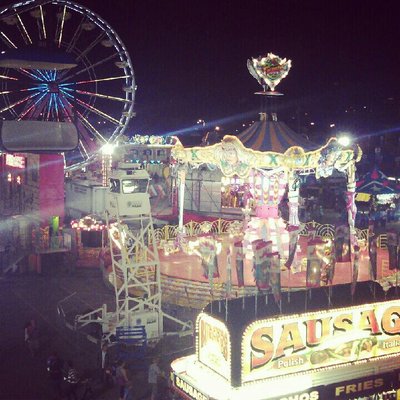
For October is, amongst the chill winds and the Trick or Treating and the falling leaves, saying goodbye to Summer for the dark, dreary Winter months, the time of the local Carnival.  A last celebration, a sudden gasp of joy before it all goes away.  In Georgia, the Georgia State Fair has moved from the central-based town of Perry (near Macon) to the Atlanta Motor Speedway just south of Atlanta (in Hampton).  The hope is to draw people from the metro area to the fair (in my opinion, they probably could get rural folk to Perry easy enough, but high gas prices are hurting attendance.) In Oklahoma, the State Fair is located off Portland Ave. in the middle of Oklahoma City.  Everyone goes to the fair.  The schools have a teacher workday called "Fair Day" so that everyone could go to the fair.  Traditionally, the fair is supposed to be used for farmers bringing stock to a market to be inspected and sold (you remember Charlotte's Web? Wilbur was taken to the "fair" to be entered into a prize, and then sold for bacon).  In the meantime, the family ate, rode rides, watched rodeos, and made a day of it.


My memories of the Oklahoma State Fair begins with my grandmother, Mema, who worked counting tickets sold for the fair.  So we got in free. It's amazing I didn't get totally lost and separated from Mema walking around there, as I was my propensity every time I went anywhere (still do). I was young enough that the rides we went on were small merry-go-rounds in the shapes of cars, spaceships, etc... The goal was to get into a vehicle and have the horn work on it, or the buttons that made the lights work.  Those old machines were probably on their last leg then, but they were magical to us.  It was either that, or gaze high into the air where the grown-up rides were.  The Tilt-a-Whirl Pirate ship that went high into the air one way, then another, or the grand Ferris Wheel that stands above the fairground and can be seen for miles.  The main ride we loved going on was the tower that lifts you high above the Oklahoma soil and lets you see the whole city.  Reminds me of the Glass Elevator on Willy Wonka. You could see the Goodholm Mansion that was moved from Oklahoma City out to the fairground.  It was an old southern style house that the historical society wanted to save from Urban Renewal, and so they moved it to the fairgrounds as an exhibit. My grandmother said she lived in the house for a short while as a child. From atop the Space Tower, you could see all the way into downtown, and it was wonderful.

So, at the end of the month, it would be so worth taking a family out to the Georgia State Fair, to experience all the rides and the food and see the cows and horses and cars (it's on the Raceway), create memories that children will have for a long time.  It's a tunnel back to yesteryear, before electronic gadgets that keep kids walking head down while somehow maneuvering around poles and doors and stuff.  Get the kids to look up for once, to sights they'll never forget.

Tuesday, October 9, 2012

White Chocolate Candy Corn; Book Christmas Trees

In 2006, a year after I began working at Borders, M&M's introduced White Chocolate M&M's, to coincide with the Pirates of the Caribbean Sea movie.  If you could have seen me when I heard the news, it would be one of the few times I've "fangirled" over something (the latest being the trailer for The Mysterious Cities of Gold, 2nd season.) Squealing with delight, I went to multiple grocery stores trying to find the elusive pieces of white heaven.  For it's the ironically named "White Chocolate" that is the greatest of candies. Having tasted it first as a white chocolate fudge  at the Cafe in Stone Mountain a long time ago, and letting it melt down my throat in explosions of creamy goodness (yep, I fangirled), it became seared into my memory as the best thing to experience at the big granite rock.

So it was with ginormous displeasure when I realized that White Chocolate M&M's were inferior and not worth getting.  I doubt I finished the sack I bought.  Here's why.  White Chocolate, when properly made, has a much lower melting point than regular chocolate. It doesn't do well in shipping in large trucks, even when refrigerated.  So, most white chocolate foods are made and sold during the winter months.  If you recall the White Chocolate covered Oreos that are always around Christmastime (which, by the way, are equally disappointing for a totally different reason. Oreos are meant to be dunked in milk, and yet the white chocolate covering prevents the cookie from dissolving inside the milk.  Thus, the Oreos are useless.  I actually threw the mostly uneaten container of WCC-Oreos away). The WC
M&M's were sold in July, and Mars company realized the issue.  They put some sort of chemical inside the white chocolate that prevented it from melting.  Wonderful..... except.... it didn't "Melt in your Mouth" either.  It wouldn't dissolve at all, leaving the flavor of the chocolate from covering every millimeter of my taste buds.  It was a major let down.

Now, I'm happy to announce, they've got it right!! White Chocolate Candy Corn M&M's, for the Halloween season, are great!  They added a little honey flavor to the sugar coating, and reconfigured the make up of the white chocolate in the middle. Great job Mars!!!  But good luck finding them!


***

For the Christmas season, I got creative and made a Book Tree for the Friends of the Library Bookstore at the Nancy Guinn Library here in Conyers, GA.  Got the idea off the Internet, looking for things to do with old Law Books.  Here is the result:


...