 ... or maybe that should be Georgia International Horse Park. I decided when this long, depressing winter began that I couldn't just stop walking, but I didn't want to continue to traverse Arabian Mountain, as I wanted to see the beauty of that area when it was warm enough to enjoy it. I wanted to stand on the mountaintops with the clear blue sky and sun reflecting off the lakes, not cloudy, dreary, overcast days where I shivered in my coats. So I picked another area for winter hiking. The Georgia International Horse Park (hereafter referred to as GIHP) was a perfect spot. The wetlands around it, seen from Google Earth, would be much better walked around when it was too cold for mosquitoes and the like to swarm around my face.

Then, after it rained, I walked under the bridge at Gees Mill Road and watched the now brown, muddy Yellow River sweep past us, leaving each drop of water, each moment, flowing endlessly away from me. It's true that if we wde into a stream bed, we've never actually waded in the same river twice, for the water is different each time, as it flows down into Lake Jackson and south from there into the sea. The rain washed out part of the path, and I realized later that it would do me no good to continue, for the bridge next to the private Railroad Tracks (made for those small toy-sized trains like Ricky Schroder had in his living room on Silver Spoons ) had been washed out many times, leaving the wood rotted away.
It's amazing how many of the wooden structures I've seen that have not been kept up here. There are

 places on the web where you can see structures of past Olympics in ruins, the trees growing over the bobsled track, now covered with moss, a highway for the squirrels and such. Such is the case here at the GIHP, but on a much smaller scale. There were places along the trails where some wooden structure had been built, perhaps to stand a camera on, or for judges, or water stations, and now these areas are crumbling, as they aren't needed anymore. I'm glad that people keep the trails up, and cut down fallen trees and the like. There are some places where it looks like strong storms have knocked over the trees, and so there are areas that look almost destroyed. There are areas of serenity, where I walked down a wide grassy path, finding nothing but the birds and the sunlight angling through the trees. I could have walked for miles and found no one about. I feel grateful that the people have let me enjoy my moments of solitude, yet I wonder, what if people could see outside their homes and televisions and smart phones? It is gorgeous, and yet I fear that the campgrounds I've seen remain vacant for much more than they are used. What of the gravel pits
 rounded by wooden benches (now half rotted), or the ones circled by granite stone, used for campfires, where boys told stories and laughed and roasted hot dogs or marshmallows in the flames? Would they remain empty while people bickered and funds dried up and everyone lost interest in raising children with any semblance of what the outdoors actually looked and felt like? The barn houses will rot and fall down, the mills along the rivers (like the one next to the Haynes Creek Nature Center) will fall silent, standing inside of tall fences meant to keep people with beer and spray paint cans away. Would these places become as invisible as the stone walls in the Factory Shoals area in Newton County?

I learned a few things while hiking these trails. Watch where you step... they are horse trails, after all. For the bike paths, walk backwards from the way bikes would travel, that way you seem them and can step out of the way in time. The falls off of some of those paths would hurt. Follow the color codes on the main trails, or you will become lost, and then walk on the other trails some other time. It might take a little bit to find some of the trail markers, but they are there. Finally, take the time to see the beauty around you. I see bikes whizzing by, their riders more interested in how many calories they've burned than the marvels they are missing. As Noel Paul Stookey said, "There's two ways to miss things. One is if they go by too fast, and the other is if we go by too fast. In some cases, it's well worth watching the rings form around the trees, and let the speeding machines just pass by. The cool thing is that, in the GIHP, there are tons of trails to hike, through rocks, swamps, fields, giant hills, forested lands, and it will take some time to walk through them all. But I have the time, and the desire, so the winter's cold won't stop me from continuing my trek through the world, nor should it.
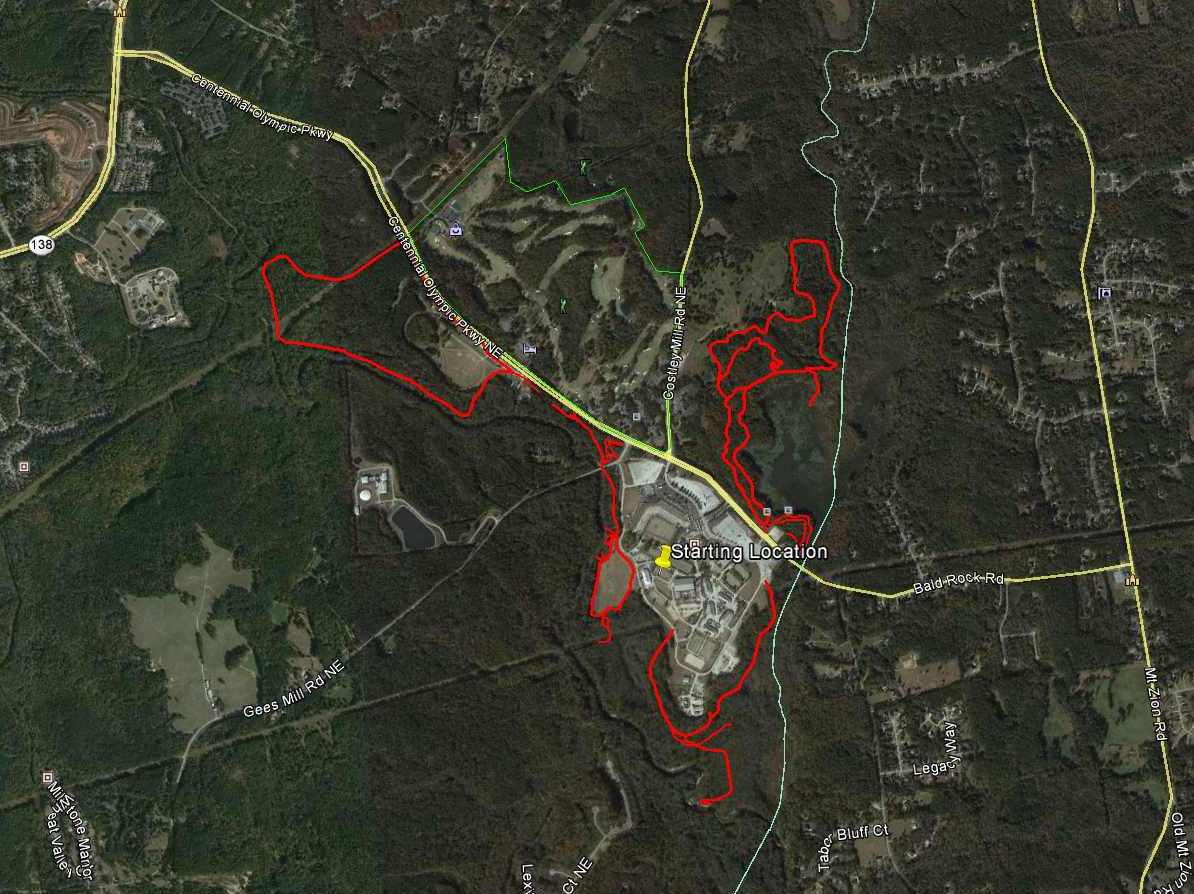 |
| Trails I've been on up to March 12th, 2014 at the GIHP |


